
Email: ainlbusshelter@gmail.com | WhatsApp: +86-18800607527
Views: 298 Author: Ainl Bus Shelter Publish Time: 2026-11-23 Origin: Site


Content Menu
● Outdoor LCD Displays vs. Printed Advertising Panels: At a Glance
● How the Two Advertising Formats Work
>> Outdoor LCD displays: hardware plus a content workflow
>> Printed advertising panels: simple media, variable construction
● Campaign Speed and Brand Consistency Across Locations
>> Where outdoor digital signage has the advantage
>> Where printed panels remain competitive
● Visibility, Readability, and Creative Flexibility
>> Compare the viewing environment, not just specifications
>> Motion is useful only when the message remains clear
● Total Cost of Ownership: Compare the Entire Campaign System
>> An illustrative break-even model
● Outdoor Durability, Maintenance, and Installation
>> Specify the complete installed assembly
>> Plan for realistic fault recovery
● Three Operational Checks That Improve the Decision
>> 1. Measure correct-message availability
>> 2. Price the cost of campaign delay
>> 3. Protect the fallback message
● Sustainability: Avoid Automatic Winners
● A Practical Pilot Before a Network-Wide Rollout
● Choosing a Manufacturing Partner for Retail Rollouts
>> Is an outdoor LCD display always better than a printed panel?
>> Can outdoor LCD advertising displays operate without internet?
>> How bright should an outdoor LCD display be?
>> Do printed advertising panels require electricity?
>> Can digital signage prove that customers saw an advertisement?
>> Should every store use the same advertising format?
An outdoor LCD display gives multi-location retailers centralized content control, scheduled promotions, and faster campaign updates. Printed advertising panels offer lower initial costs, straightforward installation, and continuous visibility without electronic playback. The better choice depends on how often your message changes, what each location requires, and how much campaign execution costs across your network.
From a manufacturing and campaign-planning perspective, I would start with one question: how much work does every advertising update create?
For a retailer changing seasonal graphics twice a year, print may remain practical. For a chain coordinating weekly offers across dozens of stores, outdoor digital signage deserves closer evaluation. The comparison is not simply screen versus poster. It is a comparison between two operating models.
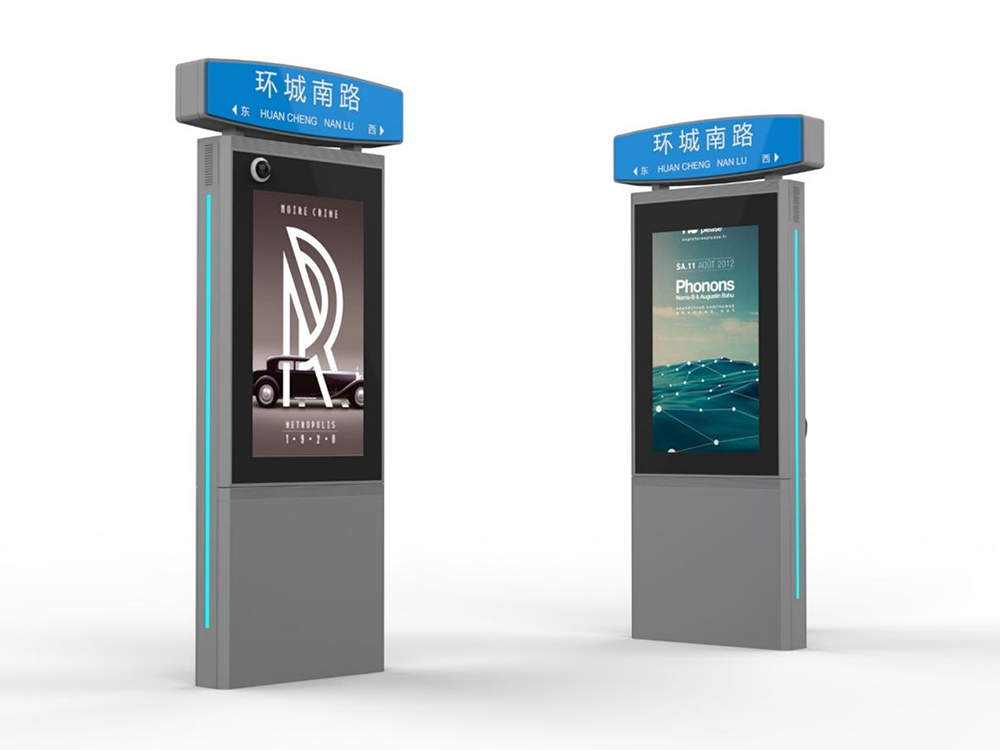
| Decision factor | Outdoor LCD display | Printed advertising panel |
|---|---|---|
| Initial investment | Higher; includes electronics and installation | Usually lower for straightforward applications |
| Content updates | Remote, with a compatible management system | Physical replacement required |
| Campaign scheduling | Supports timed content and regional playlists | Requires advance production and installation |
| Creative formats | Static graphics, animation, and video | Fixed graphics |
| Electricity | Required during operation | None for unlit panels; required for illuminated formats |
| Connectivity | Needed for remote updates; cached playback may continue offline | Not required |
| Maintenance | Electronics, enclosure, cooling, software, and cleaning | Graphics, frame, surface, and lighting where fitted |
| Best-fit campaigns | Frequent, localized, or time-sensitive promotions | Stable, long-running messages |
| Main execution risk | Equipment failure or incorrect digital publishing | Late installation or outdated graphics |
Neither format automatically produces better sales. Placement, readability, offer quality, and execution determine whether an advertisement becomes useful to customers.
An outdoor LCD advertising display uses a liquid-crystal panel with a backlight, supported by protective construction and thermal management. It differs from a direct-view LED display, even though LCD backlights commonly use LEDs.
A complete deployment may include:
- An outdoor-rated display and mounting structure.
- Electrical protection and site wiring.
- A media player or integrated playback system.
- A content management system.
- Connectivity, monitoring, and maintenance arrangements.
Remote publishing is a system capability, not something buyers should assume every screen includes.
Printed advertising panels include posters in lockable cabinets, rigid printed boards, and backlit graphics.
Their performance depends on the complete assembly: substrate, ink, protective finish, frame, installation, and exposure. A sheltered poster case and an exposed roadside panel should not share the same durability assumptions.
Print also provides a useful operational advantage: the approved message stays visible without a player, network connection, or software configuration.
The strongest argument for outdoor LCD displays is control over changing information.
A compatible platform can distribute approved content by store group, region, or schedule. Retailers can prepare breakfast and evening promotions, localize languages, and replace expired offers without shipping replacement graphics.
However, remote publishing does not remove the need for governance. One incorrect price can spread across an entire network quickly.
Define:
1. Who creates and approves content.
2. Which fields local teams may change.
3. When promotions start and expire.
4. What plays if an update fails.
5. Who verifies successful deployment.
Print works well when the message is stable and local replacement is inexpensive.
A permanent brand promise, directional message, or seasonal campaign may not justify a connected screen. Reusing standard frames also simplifies repeat production.
The hidden difficulty is synchronization. Printing, shipping, receiving, and installation must all happen before the campaign deadline. For a large network, those handoffs deserve the same scrutiny as digital uptime.
Outdoor LCD visibility depends on brightness, reflections, viewing angle, protective glass, ambient light, and content design.
As a technical benchmark, Samsung's OH55A-S lists typical brightness of 3,500 nits, automatic brightness adjustment, IP56 ingress protection, and IK10-rated protective glass. These are specifications for that model, not universal requirements or claims about Ainl products.
During procurement, request an on-site demonstration under representative sunlight. Check the display from the customer's actual approach direction, including through polarized sunglasses where relevant.
Printed graphics do not compete with sunlight through emitted brightness. However, glare, fading, shadows, and insufficient nighttime lighting can still reduce readability.
Digital displays can rotate messages, but more content does not necessarily mean more communication.
A shopper may approach halfway through a playlist. Essential information should therefore remain visible long enough to understand.
For either format:
- Lead with one offer or benefit.
- Use strong contrast and readable type.
- Keep legal conditions legible.
- Match detail to viewing distance.
- Test the final artwork at realistic scale.
Where local rules restrict animation or roadside messaging, a digital screen may need static-only content.
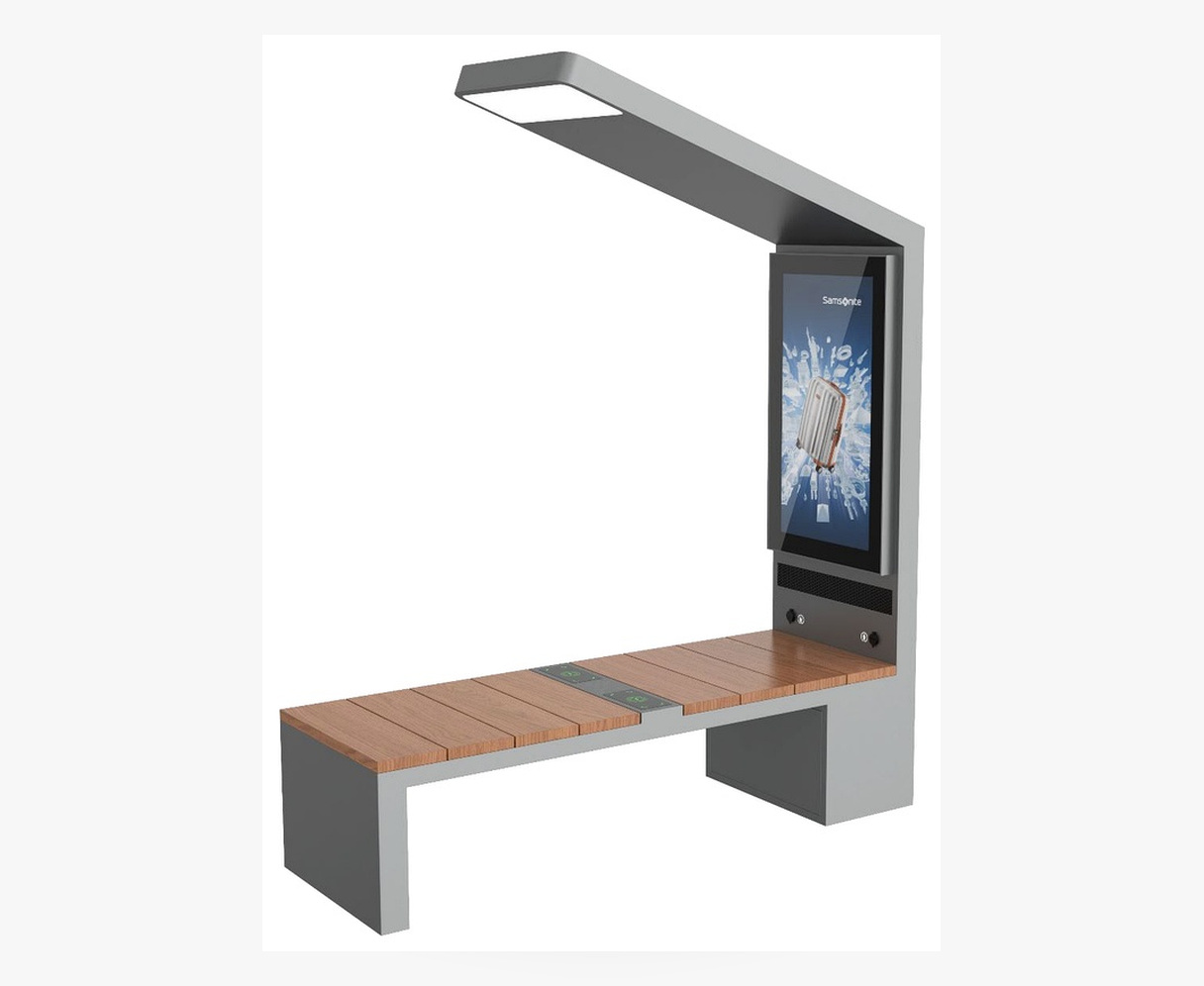
The purchase price is only one part of total ownership cost.
For LCD deployments, include equipment, freight, foundations, electrical work, installation, software, connectivity, energy, maintenance, content production, and eventual replacement.
For print, include frames, artwork adaptation, production, packing, distribution, installation labor, removals, disposal, and emergency reprints.
The following assumptions are hypothetical planning inputs, not supplier quotations or industry averages.
| Five-year assumption, per location | Outdoor LCD | Printed panel |
|---|---|---|
| Installed initial cost | $5,000 | $600 |
| Annual operating allowance | $700 | Excluded from this simplified model |
| Cost per physical campaign replacement | Not applicable | $100 |
| Campaign changes annually | 24 | 24 |
| Five-year modeled cost | $8,500 | $12,600 |
Under these assumptions, LCD costs $4,100 less per location over five years.
The break-even frequency is approximately 16 replacements annually: the $7,900 difference between LCD's modeled five-year cost and the print frame cost, divided by five years and $100 per replacement.
At only four replacements annually, modeled print expenditure falls to $2,600. Print then costs substantially less.
This example excludes financing, taxes, residual value, differences in creative costs, and exceptional repairs. Its purpose is to show why update frequency matters—not to promise savings.
A weather-resistant screen does not automatically make the entire installation suitable for its location.
Evaluate:
- Rain, dust, humidity, and condensation.
- Direct solar exposure and thermal loading.
- Coastal corrosion where relevant.
- Wind loading, foundations, and mounting.
- Cable entries, grounding, and surge protection.
- Service access and replacement procedures.
IP ratings address ingress protection. Impact ratings address a different risk. Neither alone proves structural suitability, corrosion resistance, or reliable operation in every climate.
Printed panels require similar attention to frames, fasteners, drainage, and anchoring, even though they contain fewer electronic components.
Digital maintenance should include cleaning, enclosure inspection, software support, and access to replacement parts.
Cached playback can keep previously downloaded content running during a network interruption, depending on the selected system. It does not overcome a power failure, damaged display, or expired content.
For print, define who replaces torn, faded, vandalized, or outdated graphics—and how quickly.
A powered-on screen is not necessarily showing the right campaign. A neatly installed poster may still advertise an expired offer.
Track the percentage of scheduled advertising time during which each location shows the correct, readable message.
For digital signage, combine publishing records with device monitoring and visual checks. For print, use dated installation photographs and exception reporting.
If a promotion launches late at ten locations, media production savings may conceal a larger execution problem.
Record the time between final approval and verified installation or playback. Also count staff hours spent chasing confirmations.
This reveals whether the organization needs faster media—or a better approval process.
Digital systems need approved fallback content that remains accurate when live pricing or connectivity fails.
Printed networks need spare graphics or a neutral replacement panel for damaged and withdrawn campaigns.
Fallback planning protects customers from misleading information and keeps local teams from improvising off-brand solutions.
Digital advertising can reduce repeated printing and distribution. It also requires electricity, electronics, replacement parts, and end-of-life treatment.
Printed panels may need no operating power when unlit, but repeated graphics create material and transport demands.
Compare equivalent advertising service over the same period. Include operating hours, measured energy use, replacement frequency, substrate choices, repairability, and local disposal options.
Do not assume every printed material is recyclable. Coatings, adhesives, composite layers, and local facilities can change the answer. Environmental claims should be specific and supported rather than broadly describing either format as "green."
Test representative locations before committing to a standard specification.
1. Select sites with different exposure, traffic, and operating conditions.
2. Record current print costs and campaign-change labor.
3. Install a limited LCD trial with agreed acceptance criteria.
4. Keep offers comparable across test and comparison stores.
5. Measure message accuracy, update speed, downtime, and energy consumption.
6. Assess commercial results alongside stock availability, pricing, and other promotions.
7. Expand only when operating benefits justify the investment.
Playback records demonstrate content delivery, not customer attention or incremental sales. Where possible, use matched stores and compare changes against a baseline rather than attributing every sales increase to the display.
A consistent network requires more than matching screen dimensions.
Based on its supplied company profile, Ainl brings 16 years of experience in outdoor advertising products and smart-city public facilities, supported by approximately 150,000 square meters of factory space. Its stated capabilities include provincial-level hardware and software development facilities, precision sheet-metal processing, large-scale coating, and electrical testing.
For retailers, those capabilities are relevant to repeatable structures, finishes, service access, and site-specific customization.
Ainl's OEM/ODM scope includes dimensions, structural design, colors, screen configurations, lighting, solar-power concepts, and city or retail branding. Solar feasibility should be engineered against actual energy demand, seasonal conditions, battery autonomy, and available installation space.
Request model-specific test reports, destination-market compliance documentation, drawings, warranty terms, and spare-parts commitments. Company-level qualifications do not replace product-level verification.
For your next rollout, send Ainl your location count, campaign frequency, installation photographs, climate conditions, and customization requirements. Request a side-by-side LCD and printed-panel proposal with installation scope and five-year operating assumptions.

No. LCD is strongest when frequent updates and centralized control justify its costs. Print remains attractive for stable messages and simple installations.
Some systems play locally stored content offline. Remote updates and live information generally require connectivity. Confirm caching and fallback behavior before purchasing.
There is no single correct brightness for every site. Assess sunlight, reflections, viewing distance, nighttime conditions, and local requirements through a representative demonstration.
Unlit panels do not. Backlit and externally illuminated panels require power, which should be included in operating-cost comparisons.
Playback logs alone cannot. They show delivery activity. Customer exposure and commercial impact require separate measurement methods.
Not necessarily. A hybrid network can use digital displays at frequently updated locations and printed panels where messages remain stable.
- Samsung. "55-inch OHA-S Series Full Outdoor Signage Display." Product-specific brightness, automatic adjustment, ingress protection, and impact-protection specifications. [samsung]
- Samsung. "Stand Out, Outside: OH Series Full Outdoor Signage Datasheet." Technical specifications and outdoor operating information. [image-us.samsung]
- BrightSign. "Digital Signage Device Management Solutions." Centralized fleet management, monitoring, diagnostics, and scheduling capabilities. [brightsign]
- BrightSign. "Digital Signage for Frontline Workers." Local caching, offline playback, remote monitoring, and fallback-content discussion. [brightsign]
- U.S. Federal Trade Commission. "Environmental Claims: Summary of the Green Guides." Guidance on substantiating and qualifying environmental and recyclability claims. [ftc]


