
Email: ainlbusshelter@gmail.com | WhatsApp: +86-18800607527
Views: 220 Author: Ainl Bus Shelter Publish Time: 2026-09-08 Origin: Site


Content Menu
● Understanding the Two Power Systems
>> What Is a Solar Bus Shelter?
>> What Is a Battery-Powered Bus Shelter?
● Solar Bus Shelter vs Battery-Powered Bus Shelter Comparison
● Energy Demand Comes Before Product Selection
>> Typical Bus Shelter Electrical Loads
>> A Practical Daily Energy Calculation
● Why Solar Often Wins in Permanent Remote Projects
>> Lower Dependence on Site Visits
>> Better Fit for Smart-City Infrastructure
>> Stronger Resilience During Outages
● Where Battery-Powered Shelters Make Sense
>> Temporary Transit and Construction Routes
>> Projects With Strict Visual Requirements
● Expert Design Checklist for Remote Locations
>> 2. Separate Critical and Optional Loads
>> 4. Plan for Maintenance Before Installation
● Materials, Safety, and Outdoor Durability
● Total Cost: Look Beyond Initial Purchase Price
>> Solar Bus Shelter Cost Drivers
>> Battery-Powered Shelter Cost Drivers
● Recommended Selection by Scenario
● Choosing a Custom Solution From Ainl
● FAQ
>> 1. Can a solar bus shelter work at night?
>> 2. How many solar panels does a bus shelter need?
>> 3. Is a battery-powered bus shelter cheaper than a solar bus shelter?
>> 4. Can solar bus shelters power digital advertising screens?
>> 5. What happens during several cloudy days?
>> 6. Are solar bus shelters suitable for cold, hot, coastal, or dusty locations?
>> 7. What information is needed to customize an off-grid bus shelter?
For remote transit stops, the choice between a solar bus shelter and a battery-powered bus shelter directly affects installation speed, operating reliability, maintenance workload, and the long-term value of the public infrastructure. Both systems can power LED lighting, digital passenger information displays, CCTV cameras, USB charging ports, advertising screens, Wi-Fi equipment, and emergency call devices—but they obtain and manage energy in very different ways.
A solar bus shelter generates electricity on-site through photovoltaic panels and normally stores surplus power in an integrated battery bank. A battery-powered bus shelter, by contrast, relies primarily on batteries that are charged before installation or recharged periodically from the electrical grid, a mobile generator, or another external power source. For isolated roads, rural transport routes, construction zones, tourist destinations, industrial parks, and areas without practical grid access, the right decision depends less on a single product feature and more on a complete assessment of local sunlight, energy demand, access for maintenance, safety requirements, and planned smart-city functions.
For Ainl, an experienced manufacturer and solution provider for bus stop shelters, outdoor advertising products, and smart-city public facilities, energy-system selection should be treated as an integrated engineering decision. The shelter structure, solar-panel position, battery enclosure, LED lighting, display brightness, electrical protection, branding elements, and maintenance access must work together as one reliable outdoor system.
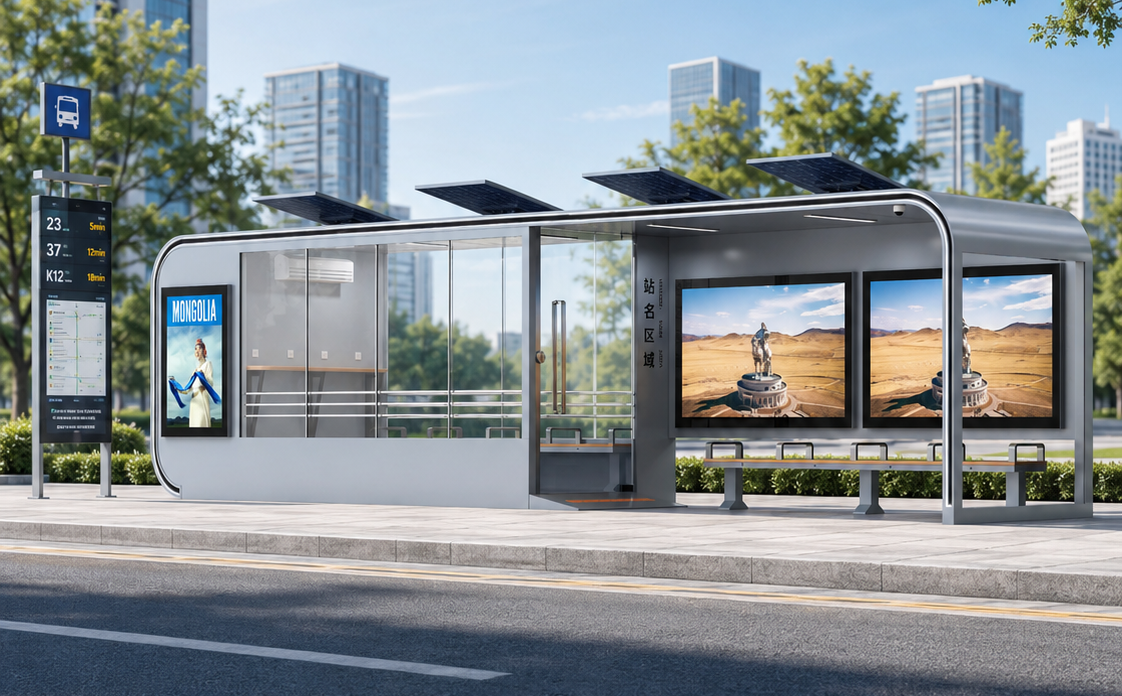
A solar bus shelter uses photovoltaic panels to convert sunlight into electricity. The generated power is managed by a solar charge controller and stored in batteries for use at night or during low-light conditions. Photovoltaic cells convert sunlight directly into electricity, while battery storage makes that energy available when generation is unavailable, such as after sunset or during cloudy weather.
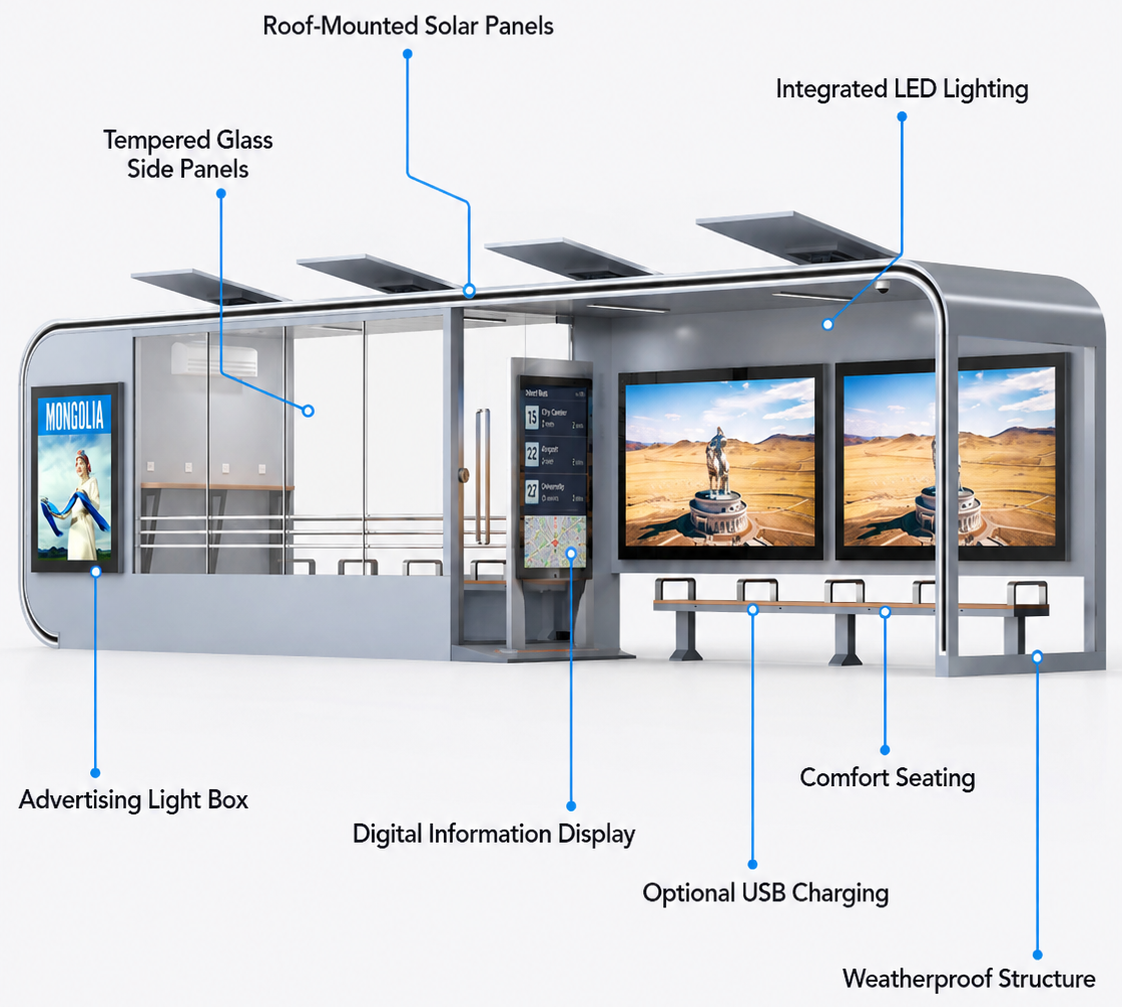
A typical solar-powered bus shelter may include:
- Roof-mounted, pole-mounted, or vertical photovoltaic panels
- A solar charge controller with energy-management logic
- Lithium battery packs or other battery technologies
- LED lighting
- Passenger information display or e-paper timetable
- CCTV camera and communication equipment
- USB or wireless charging module
- Emergency button or help-point device
- Optional advertising lightbox or low-power digital screen
- Weatherproof electrical cabinet and cable protection
The central advantage is clear: the shelter can generate its own electricity where trenching, utility connection, or monthly power bills are impractical.
However, a solar bus shelter is not simply a standard shelter with a panel attached. It must be designed around local solar resource conditions, shading patterns, equipment load, battery autonomy, panel orientation, vandal resistance, snow and wind loading, and future expansion needs.
A battery-powered bus shelter uses a battery bank as its principal energy source. The battery may be charged at a workshop before deployment, topped up through a nearby utility connection, charged from a service vehicle, or supported by a temporary generator or portable solar unit.
This option is commonly considered when:
- The project site has severe shading from buildings, trees, hills, or elevated roads
- The shelter is temporary or relocatable
- The site has low power consumption
- Solar panels would create architectural, planning, theft, or visual-design concerns
- The project requires fast short-term deployment
- An existing grid charging point is nearby but a permanent cable connection is not justified
A battery-only shelter can be a practical solution for short-duration applications. But without on-site generation, every watt-hour used must eventually be replenished by a person, vehicle, or external charging infrastructure. That recurring operational requirement becomes increasingly important as the shelter adds smart equipment.
The best energy system is rarely determined by purchase price alone. Municipalities, transit agencies, contractors, developers, and advertising operators should compare the two options across the full service life of the shelter.
| Evaluation Factor | Solar Bus Shelter | Battery-Powered Bus Shelter |
|---|---|---|
| Primary energy source | Sunlight captured by photovoltaic panels | Pre-charged or externally recharged battery bank |
| Suitability for remote locations | Excellent where solar exposure is sufficient | Best for temporary, low-load, or heavily shaded locations |
| Need for external charging visits | Usually low after commissioning | Often high, depending on energy consumption |
| Installation complexity | Requires solar-resource review, panel positioning, and energy sizing | Faster physical deployment when the battery is already charged |
| Upfront equipment cost | Typically higher due to PV modules, mounting, controller, and battery storage | May be lower initially if capacity and loads are limited |
| Long-term operating cost | Potentially lower because electricity is generated on site | Can rise because of charging labor, transport, and downtime risk |
| Resilience during grid outage | High, provided the system is properly sized and maintained | Limited to the battery's remaining charge |
| Support for smart features | Strong when panel and battery capacity are correctly engineered | Restricted by battery capacity and recharge frequency |
| Seasonal sensitivity | Performance changes with sunlight, weather, shading, and panel cleanliness | Runtime changes with load, battery condition, and charging discipline |
| Best use case | Permanent remote transit stops and off-grid smart-city infrastructure | Temporary stops, event sites, construction projects, or low-energy shelters |
Choose a solar bus shelter when the stop is permanent, receives useful sunlight, and must support lighting or digital features with minimal routine site visits.
Choose a battery-powered bus shelter when the stop is temporary, heavily shaded, very low in energy demand, or can be serviced easily and frequently.
For many public projects, the strongest answer is actually a solar-plus-battery bus shelter. Solar panels provide daily energy generation, while batteries deliver nighttime power and short-term autonomy. Energy storage is particularly valuable because solar generation and electrical demand often occur at different times.
A common project mistake is to select the shelter energy system before calculating the actual electrical load. A simple illuminated shelter has a completely different energy profile from a smart station with a high-brightness advertising display, real-time bus information, cameras, routers, environmental sensors, and mobile charging.
The table below shows why equipment selection matters. These values are planning examples only; final sizing should be based on the selected devices, operating schedule, location, and local climate.
| Equipment | Typical Operating Pattern | Energy Impact |
|---|---|---|
| LED roof lighting | Nighttime operation, often 8–14 hours daily | Low to moderate |
| LED advertising lightbox | Extended evening or all-night operation | Moderate |
| Real-time passenger information display | Continuous or scheduled operation | Moderate |
| E-paper timetable display | Intermittent updates | Very low |
| CCTV camera | 24-hour operation | Moderate |
| 4G/5G router or Wi-Fi module | 24-hour operation | Moderate |
| USB charging ports | Variable passenger use | Variable |
| High-brightness LCD advertising screen | Long daily operating hours | High |
| Heating, cooling, or large fans | Seasonal operation | High to very high |
A shelter with two LED lamps and an e-paper timetable may be straightforward to run with a compact solar-and-battery configuration. A shelter with a large digital advertising screen can require a much larger photovoltaic array, higher-capacity battery system, stricter energy-management rules, or a grid connection.
Before choosing a power configuration, estimate daily consumption:
Daily Energy Demand (Wh)=∑(Device Power in W×Operating Hours)
For example:
- Four 12 W LED fixtures operating for 12 hours: 4×12×12=5764 \times 12 \times 12 = 5764×12×12=576 Wh
- A 15 W passenger information display operating for 18 hours: 15×18=27015 \times 18 = 27015×18=270 Wh
- A 10 W camera operating for 24 hours: 10×24=24010 \times 24 = 24010×24=240 Wh
- A 12 W router operating for 24 hours: 12×24=28812 \times 24 = 28812×24=288 Wh
Estimated daily energy demand:
576+270+240+288=1,374 Wh/day
This preliminary figure should then be adjusted for battery charging losses, controller losses, cable losses, temperature effects, reserve capacity, and expected weather conditions. Energy storage always involves some conversion and retrieval loss, so the system should not be designed around the theoretical minimum battery capacity.
The greatest operational advantage of a solar bus shelter is not simply that it uses renewable energy. It is that the shelter can reduce dependence on repeated charging visits.
For a battery-only bus shelter, a maintenance team may need to visit every few days or weeks, depending on battery size and energy use. That creates recurring costs for labor, vehicles, scheduling, charging logistics, and site access. If a service visit is delayed because of severe weather, staffing shortages, road closures, or equipment failure, the shelter may lose lighting and passenger-facing functionality.
A solar-powered bus shelter can replenish its battery automatically during daylight hours. This is particularly valuable for stops located on rural highways, airport access roads, factory campuses, tourism corridors, logistics parks, suburban expansion areas, and remote municipal routes.
Remote shelters are increasingly expected to do more than provide a roof and seating. They can become small, connected public-service nodes.
A correctly engineered solar bus shelter may support:
- Energy-efficient LED lighting
- Real-time arrival information
- Digital route maps
- Security cameras
- Emergency communication
- Public Wi-Fi
- Environmental monitoring
- USB charging
- Low-power advertising or public-information displays
- Solar-powered signage for safer nighttime visibility
Solar-powered shelter products already demonstrate that off-grid systems can integrate information, multimedia, communication, and energy-management functions. One commercially described smart solar shelter configuration lists 1,200 W photovoltaic power and a 512 Ah battery, illustrating the scale required when a shelter is designed for more than basic lighting.
A grid-independent solar bus shelter can remain useful during an electrical outage if its photovoltaic generation, battery reserve, controller, and critical loads are correctly configured. Battery systems can supply backup electricity, but their value depends on how much energy remains available and whether there is a source to recharge them.
For remote locations, resilience should be defined in practical terms:
- Can the shelter still provide lighting after several cloudy days?
- Can the emergency button and communications system remain active?
- Can the passenger information display switch into low-power mode?
- Can the system prioritize safety loads over advertising loads?
- Can maintenance staff remotely identify low battery state before service is required?
Ainl can design the electrical architecture so critical functions receive priority. For example, the controller can reduce advertising brightness or temporarily disable USB charging when battery state of charge falls below a defined threshold, while preserving lighting and emergency communication.
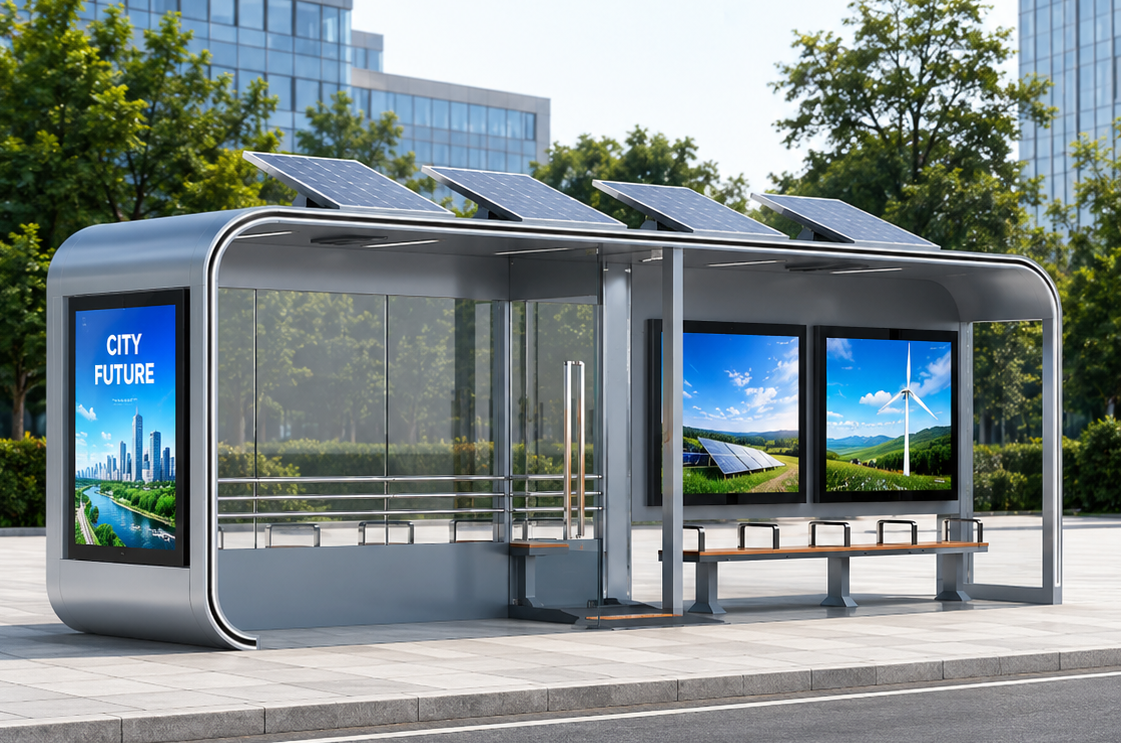
Battery-powered shelters should not be viewed as inferior. They are often the most practical answer when project conditions are specific and well defined.
Temporary bus stops may be needed during road reconstruction, rail replacement services, large events, airport expansion, or staged urban-development projects. In these cases, the shelter may be moved within months. A battery-powered unit can be deployed quickly without waiting for grid connection work or a full solar engineering study.
The key requirement is a realistic service plan. The operator should know:
- Expected daily energy consumption
- Minimum runtime between charging visits
- Exact charging responsibility
- Spare-battery availability
- Battery transport and lifting procedures
- Low-charge alert process
- Weather-related service contingencies
Dense city centers can create difficult solar conditions. Tall buildings, elevated structures, mature trees, tunnels, and narrow streets may block direct sunlight for much of the day. In these cases, roof-mounted photovoltaic panels may produce insufficient energy even if the shelter appears to be outdoors.
A battery-powered shelter may be appropriate if the load is small and personnel can recharge it easily. Another option is a hybrid design: a small solar array supports low-power devices, while periodic external charging maintains battery reserve.
Some heritage districts, landmark streetscapes, and premium commercial developments impose strict architectural rules. Large visible solar panels may conflict with the approved visual language. Ainl can address this through customized panel arrangement, integrated roof geometry, vertical solar modules, matched-color frames, concealed wiring, and tailored shelter profiles—but a battery-focused design may still be chosen when visual constraints override energy-generation potential.
The right energy system begins with a site survey, not a generic catalog specification. Below is a practical decision process for public-sector buyers, contractors, and developers.
Review sunlight availability across the year, not only on the day of inspection.
Check:
- Seasonal shading from nearby buildings and trees
- Roof orientation and usable photovoltaic area
- Local snowfall, dust, sand, salt spray, and rainfall
- Potential shading from buses, trucks, signs, and street furniture
- Risks of vandalism or unauthorized panel access
A site that performs well in summer may produce much less energy in winter. The system must be sized for the operating conditions that matter most, particularly when passenger safety lighting is required during darker months.
Not every device needs equal priority. Divide shelter functions into categories:
| Priority Level | Example Loads | Recommended Energy Strategy |
|---|---|---|
| Critical | Safety lighting, emergency call button, essential communications | Protected battery reserve and automatic priority control |
| Important | Passenger information, CCTV, network router | Scheduled operation and low-power fallback mode |
| Optional | USB charging, decorative lighting, advertising screen | Reduced output or automatic shutdown during low battery conditions |
This approach protects the public-service function of the shelter. A passenger waiting at night benefits more from reliable lighting and information access than from a high-brightness advertising display.
Battery autonomy means how long the shelter can operate without meaningful solar generation or external charging.
For remote locations, autonomy should reflect local risk conditions:
- Three days may be sufficient in stable, sunny areas with basic lighting loads.
- Five or more days may be appropriate where weather is variable, access is difficult, or critical equipment must stay online.
- Longer autonomy may be required for emergency corridors, isolated communities, or locations with limited maintenance access.
One smart bus stop example specifies a minimum of five days of battery backup autonomy while considering local weather conditions. This shows why daily solar production alone is not enough when designing a reliable off-grid public facility.
Even the best solar bus shelter requires planned maintenance. Dust, leaves, snow, bird droppings, corrosion, loose fasteners, aging batteries, damaged cables, and controller alarms can reduce performance.
A practical maintenance plan should include:
- Scheduled photovoltaic panel cleaning based on local conditions
- Remote monitoring of battery state of charge and equipment alarms
- Inspection of waterproof seals, locks, cable glands, and grounding
- Battery health checks and replacement planning
- Cleaning and inspection of LED fixtures and displays
- Review of energy-use data after seasonal changes
- Spare-parts strategy for controllers, batteries, and communication modules
Ainl's integrated manufacturing capabilities—including sheet-metal processing, coating, electrical testing, and software-hardware development support—can help buyers coordinate shelter structure and electrical system requirements within one project solution rather than treating each component as an unrelated purchase.
Energy selection must be connected to the physical construction of the shelter. A remote solar bus shelter is exposed to wind, rain, ultraviolet radiation, vibration, temperature swings, dust, salt, and potential vandalism. The photovoltaic system should not compromise shelter safety or structural appearance.
A robust outdoor design typically considers:
- Galvanized steel, aluminum alloy, stainless steel, or customized structural materials
- High-quality outdoor powder coating for corrosion resistance
- Impact-resistant glazing or polycarbonate panels where appropriate
- Secure solar-panel mounting designed for local wind load
- Concealed conduits and tamper-resistant electrical enclosures
- Waterproof connectors and weatherproof cabinet construction
- Grounding, surge protection, overcurrent protection, and electrical isolation
- Thermal management for batteries and electronic components
- Lockable maintenance access without exposing passengers to electrical hazards
Battery storage systems typically require management equipment that monitors operating conditions such as voltage, temperature, charging state, and discharge behavior. Battery management and energy-management functions are particularly important in outdoor infrastructure because they help protect battery life and support controlled operation of connected loads.
For public projects, the safest specification is not merely "solar panel + battery." It is a complete package with structural calculations, weather protection, electrical protection, maintenance access, and documented quality control.
A battery-powered bus shelter may appear less expensive at the beginning because it does not require a large photovoltaic array or dedicated solar mounting system. But the lower purchase price can be offset by recurring charging and maintenance operations.
- Photovoltaic modules and mounting system
- Battery capacity and battery chemistry
- Charge controller and energy-management system
- Structural reinforcement for panel installation
- Remote monitoring and communication hardware
- Installation and commissioning
- Future battery replacement
- Battery capacity
- External charger and charging infrastructure
- Labor for charging, swapping, or transporting batteries
- Vehicle trips to remote locations
- Service interruptions caused by missed recharging
- Higher battery cycling or deeper discharge risk
- Spare-battery inventory
The most useful financial question is:
> What is the total cost of keeping the shelter safely operational for the next five to ten years?
For a permanent remote stop, the ability to generate electricity on site can often justify the additional initial investment. For a short-term or frequently relocated facility, a battery-powered arrangement may remain more economical.
| Remote Location Scenario | Recommended System | Why |
|---|---|---|
| Rural highway stop with strong sunlight | Solar bus shelter with battery storage | Minimizes charging visits and supports long-term autonomous operation |
| Temporary construction shuttle stop | Battery-powered or portable hybrid shelter | Fast deployment and easier relocation |
| Industrial park with night-shift workers | Solar-plus-battery shelter with priority lighting | Improves nighttime safety and avoids costly cable trenching |
| Dense urban canyon with limited sunlight | Battery-powered, grid-assisted, or hybrid shelter | Solar output may be insufficient because of persistent shading |
| Tourist trailhead or scenic route | Integrated solar bus shelter | Supports off-grid public service while matching local landscape design |
| Remote stop with CCTV and real-time information | Larger solar-plus-storage system | Connected devices need dependable daily energy and reserve capacity |
| Heritage district with visual restrictions | Customized low-profile solar or battery-supported system | Balances architectural requirements with functional energy needs |
Ainl can support OEM and ODM customization for remote bus shelter projects, including shelter dimensions, structural design, color systems, solar-panel configuration, battery capacity, lighting, display equipment, branding elements, and communication modules. The goal should be to create a shelter that fits the local transport environment rather than forcing every location into the same power configuration.
When preparing a request, provide the following project information:
1. Installation city or region and expected climate conditions
2. Shelter quantity, dimensions, and intended service life
3. Site photos, orientation, and known shading conditions
4. Required equipment, including lighting, displays, cameras, Wi-Fi, charging, and advertising
5. Expected daily operating hours for each device
6. Required battery autonomy during cloudy weather or outages
7. Available maintenance frequency and remote-monitoring expectations
8. Local wind, snow, corrosion, and electrical compliance requirements
9. Desired visual identity, colors, logos, and municipal branding
10. Whether the shelter is permanent, temporary, relocatable, or part of a phased smart-city rollout
The best remote-location shelter is the one that keeps passengers safe, informed, and comfortable every day—not only when the weather is ideal or a technician is available.
For most permanent, off-grid, or difficult-to-service locations, a solar bus shelter with properly sized battery storage is the stronger long-term solution. It offers on-site energy generation, reduces reliance on manual recharging, supports smart-city equipment, and can maintain essential services during grid disruptions.
A battery-powered bus shelter remains a smart choice for temporary deployments, very low-energy stops, heavily shaded sites, or projects with reliable and frequent maintenance access. The decision should be based on a complete load assessment, local solar study, autonomy target, structural design, and operational plan.
Ready to develop a remote bus shelter project? Share your location, shelter size, electrical equipment list, local weather conditions, and branding requirements with Ainl. Our team can help configure a customized solar bus shelter, battery-powered bus shelter, or hybrid public-facility solution that balances reliability, appearance, safety, and lifetime operating cost.
Yes. A solar bus shelter uses photovoltaic panels to generate electricity during daylight hours and stores energy in batteries for nighttime use. The required battery capacity depends on lighting hours, display equipment, cameras, communication devices, and the desired backup period.
There is no universal answer. The required number and size of solar panels depend on the shelter's daily energy consumption, local sunlight, seasonal weather, roof area, shading, panel orientation, battery capacity, and required system autonomy. A basic lighting shelter may need far less solar capacity than a shelter with digital advertising screens and 24-hour CCTV.
It may cost less initially, especially for a simple or temporary shelter. However, it can create higher long-term costs if maintenance personnel must repeatedly travel to recharge or replace batteries. For permanent remote locations, solar generation can reduce ongoing charging logistics.
Yes, but digital screens can have substantial energy demand, especially if they are high-brightness LCD displays operating for long hours. The shelter may require a larger photovoltaic array, larger battery bank, energy-management controls, reduced night brightness, scheduled operating hours, or a hybrid/grid-connected solution.
The answer depends on battery autonomy and energy-management settings. A properly designed system stores reserve energy and can prioritize critical loads such as safety lighting and emergency communications. Optional functions, such as USB charging or advertising displays, can be automatically reduced or switched off to preserve battery power.
Yes, if the shelter is engineered for the local environment. The project should consider battery temperature performance, ventilation, corrosion resistance, waterproofing, panel-cleaning needs, wind load, snow load, UV exposure, and salt or dust accumulation.
Provide the installation location, site photos, solar exposure or shading conditions, shelter dimensions, required electrical devices, daily operating hours, desired backup days, local climate, branding requirements, and relevant electrical or structural standards. This allows the supplier to size the photovoltaic, battery, lighting, and control systems accurately.
1. U.S. Department of Energy. [Solar Integration: Solar Energy and Storage Basics]
2. U.S. Department of Energy. [Solar-Plus-Storage 101]
3. U.S. Energy Information Administration. [Solar Energy]
4. NLR Research Hub. [Battery Storage for Resilience]
5. Seedia. [Smart Solar Powered Bus Shelter]
6. EnGoPlanet. [Smart Solar Powered Bus Stop & Shelter Station]
7. NorCal Controls. [BESS Basics: Battery Energy Storage Systems for PV-Solar]
8. Clean Energy Group. [Valuing the Resilience Provided by Solar and Battery Storage]


