
Email: ainlbusshelter@gmail.com | WhatsApp: +86-18800607527
Views: 243 Author: Ainl Bus Shelter Publish Time: 2026-10-11 Origin: Site


Content Menu
● Solar Bus Shelter vs Electric Bus Shelter: Understanding the Difference
>> What Is a Solar Bus Shelter?
>> What Is an Electric Bus Shelter?
● Solar and Grid-Powered Bus Shelters Compared
● Which Shelter Infrastructure Actually Supports EV Transit?
>> Separate Passenger Energy from Vehicle Charging
>> Use Electrification Growth to Guide Infrastructure Planning
● Solar Bus Shelter Advantages and Limitations
>> Where Solar-Powered Shelters Offer Strong Value
>> Where Solar Becomes More Challenging
● Grid-Powered Electric Bus Shelter Advantages and Limitations
>> Why Grid Power Suits Demanding Digital Equipment
>> Why a Grid Connection Does Not Guarantee Resilience
● Practical Engineering Example: Size the Loads Before Selecting the Shelter
● Lifecycle Cost: Compare Complete Installed Systems
● Accessibility and Structural Quality Come Before Smart Features
● A Procurement Checklist for Future-Ready Bus Shelters
● How Ainl Supports Customized Transit Shelter Projects
● Which Infrastructure Should You Choose?
>> Can a Solar Bus Shelter Charge an Electric Bus?
>> Does an Electric Bus Shelter Require Electric Buses?
>> Can Solar Bus Shelters Work at Night?
>> Which Shelter Has Lower Maintenance Costs?
>> Can a Solar Shelter Operate a Digital Advertising Screen?
>> What Makes a Shelter Future-Ready?
A solar bus shelter is often the better choice for low-power passenger amenities where grid connections are difficult or expensive. An electric bus shelter, understood here as a grid-powered shelter, usually suits energy-intensive displays and continuously connected equipment. For future EV transit, the strongest solution may combine both technologies.
The essential distinction is function: powering a passenger shelter is not the same as charging an electric bus. A shelter can improve comfort, information access, and operational resilience without supplying traction energy to vehicles.
From a manufacturer's perspective, the right decision starts with the site, electrical loads, and service requirements—not with choosing the technology that sounds more advanced.
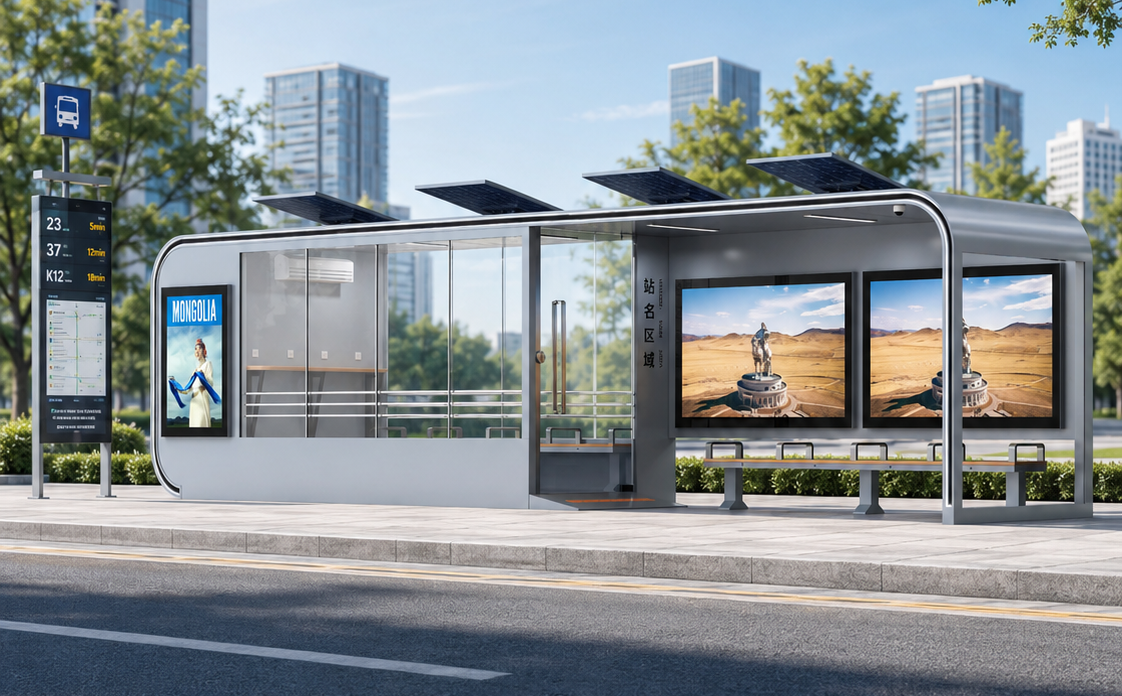
A solar bus shelter uses photovoltaic panels to generate electricity for selected shelter equipment. An off-grid configuration typically includes solar modules, a charge controller, battery storage, protective devices, and compatible electrical loads.
Applications can include:
- LED lighting and illuminated signage.
- Low-power passenger information displays.
- Communications equipment and environmental sensors.
- Carefully managed USB charging points.
Its capabilities depend on the complete energy budget. Adding a large advertising screen can fundamentally change the required panel capacity, battery size, and feasibility.
Solar shelters can also be grid-connected or hybrid. "Solar" therefore does not automatically mean "fully independent of the electricity network."
"Electric bus shelter" is not a universally standardized infrastructure category. In this comparison, it means a shelter whose lighting, displays, and other equipment primarily receive electricity from the grid.
It should not be confused with an electric-bus charging station. A charging installation requires dedicated equipment, electrical capacity, protective systems, and coordination with the transit operator and utility.
Both shelter types can serve electric, diesel, or mixed fleets. The bus propulsion system does not determine how passenger amenities must receive power.
| Decision factor | Solar bus shelter | Grid-powered electric bus shelter |
|---|---|---|
| Primary energy source | On-site photovoltaic generation | Utility electricity |
| Nighttime operation | Requires stored energy or another supply | Uses grid supply while available |
| Suitable electrical loads | Efficient lighting and carefully selected electronics | Continuous displays and higher-power equipment |
| Site constraints | Sunlight, shading, roof area, battery placement | Connection availability, trenching, electrical approvals |
| Outage resilience | Possible within battery and generation limits | Requires backup for continued operation |
| Maintenance priorities | Panels, batteries, controllers, wiring | Wiring, protective devices, connected equipment |
| Expansion potential | Limited by generation and storage capacity | Limited by connection and circuit capacity |
| Electric-bus charging | Ordinary shelter systems are not charging infrastructure | Possible only through a separately engineered charging installation |
Neither option is universally cheaper or more reliable. A sunny roadside stop with modest lighting needs differs substantially from a shaded urban interchange with multiple digital displays.
Future EV transit needs two related but distinct systems:
1. Passenger infrastructure that provides shelter, lighting, accessibility, and information.
2. Vehicle infrastructure that supplies enough energy to operate the fleet.
The difference in electrical scale is substantial. A US Department of Energy deployment guide describes typical bus charging levels of 65–150 kW for slower charging and 350–600 kW for fast charging. Actual requirements depend on the vehicle, charging architecture, and operating plan.
These are charger power ratings, not daily energy consumption figures. They should not be directly compared with a shelter's daily kilowatt-hour demand.
A compact shelter roof should therefore not be promoted as a practical replacement for dedicated bus charging infrastructure without project-specific engineering evidence.
The International Energy Agency's Global EV Outlook 2026 reports that electric bus sales approached 70,000 globally in 2025. Battery-electric vehicles represented 98% of those electric bus sales.
That growth strengthens the case for coordinated infrastructure planning. However, it does not mean every stop needs a charger.
Charging locations should follow route energy requirements, schedules, available layover time, depot arrangements, and electrical capacity. Passenger shelters should follow ridership, accessibility, comfort, and information needs.
The two planning processes should connect without becoming interchangeable.
Solar-powered bus shelters deserve serious consideration where obtaining a grid connection would require substantial civil works.
Examples include:
- Rural stops with limited nearby electrical infrastructure.
- Roadside locations where trenching is disruptive.
- New developments awaiting permanent utility connections.
- Stops needing efficient lighting rather than intensive multimedia systems.
For these applications, independent generation may simplify the electrical installation. It does not eliminate foundation works, permits, structural calculations, or maintenance responsibilities.
Solar can also support energy-conscious public infrastructure. The environmental benefit should nevertheless be assessed across manufacturing, operation, maintenance, and component replacement—not assumed from the presence of panels alone.
Shading from buildings, trees, or future development can reduce generation. Seasonal sunlight also matters.
A design based on favorable annual averages may fail to maintain the required service during the most demanding winter period.
Battery storage introduces additional considerations:
- Usable capacity rather than nameplate capacity.
- Temperature-dependent performance.
- Battery protection and enclosure design.
- Expected degradation and replacement access.
- Priority settings when available energy becomes limited.
From a specification perspective, "operates all night" is incomplete. Buyers should define the lighting schedule, required brightness, connected loads, and acceptable performance during prolonged poor weather.
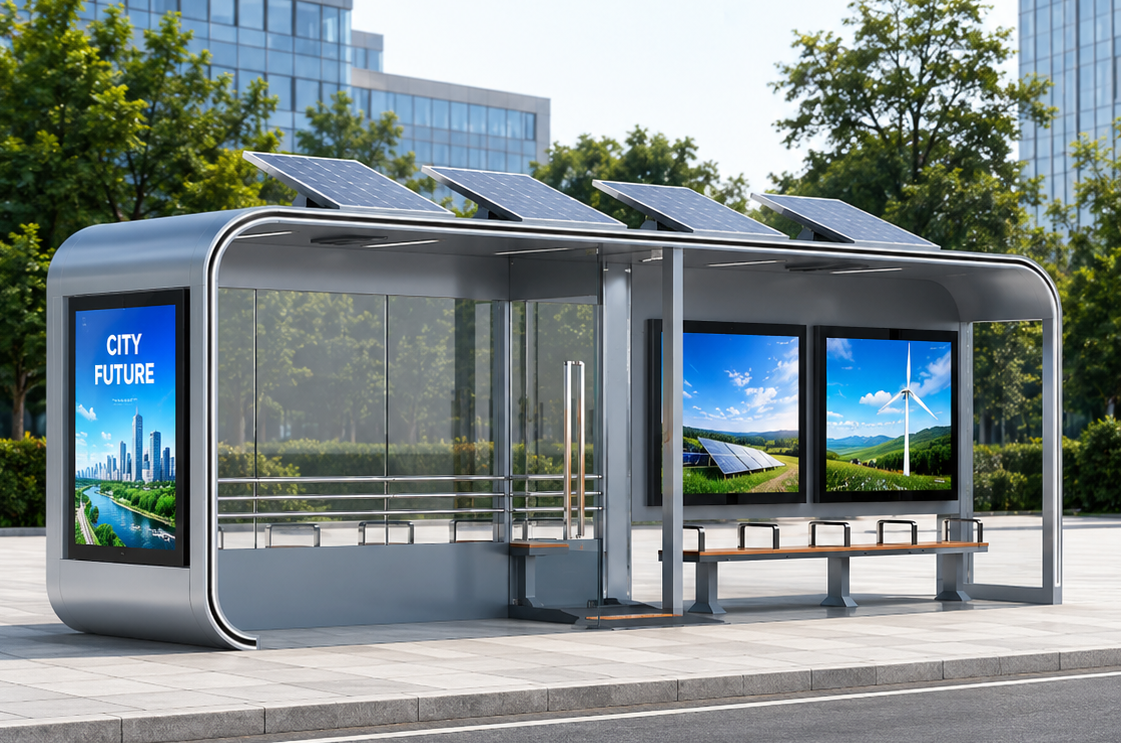
A grid-powered shelter is often the more practical starting point for large advertising displays, frequently updated information screens, and continuously operating communications equipment.
It avoids making daily operation entirely dependent on local solar production and battery recovery.
However, the available supply still needs verification. Connection capacity, circuit protection, equipment compatibility, metering, and isolation arrangements remain project-specific.
For future expansion, reserve cable routes and cabinet space where practical. Adding equipment later should not require unnecessary dismantling of the shelter.
Grid-powered shelters can stop operating during an outage unless backup is provided.
A battery backup system can preserve selected functions, but designers should distinguish essential loads from optional ones. Maintaining safety lighting and passenger information may matter more than keeping an advertising screen active.
Grid installation can also involve utility coordination, pavement reinstatement, connection fees, and approval delays. Where electricity is nearby and accessible, these costs may be manageable. Where it is not, they can change the commercial comparison significantly.
Consider an illustrative solar bus shelter with the following equipment:
| Equipment | Assumed power | Daily operation | Daily energy |
|---|---|---|---|
| LED lighting | 30 W | 12 hours | 360 Wh |
| Low-power information display | 15 W | 18 hours | 270 Wh |
| Communications equipment | 5 W | 24 hours | 120 Wh |
| Total | — | — | 750 Wh |
These assumptions are a design example, not measured Ainl product performance.
If the site provides three equivalent peak-sun-hours daily and the assumed combined system efficiency is 75%, the simplified array estimate is:
PV capacity=750 Wh/(3 h×0.75)≈333 W
For two days of autonomy and an assumed 80% usable battery fraction:
Battery capacity=(750 Wh×2)/0.80=1,875 Wh
These figures are preliminary energy-balance estimates. Final sizing must address worst-season weather, shading, battery temperature, aging, conversion losses, and recovery after cloudy periods.
Now add a hypothetical 200 W advertising display operating for 16 hours. It consumes another 3,200 Wh daily—more than four times the original shelter load.
This illustrates why screen selection should precede solar-system selection, not follow it.
Purchase price alone cannot establish which shelter offers better value.
A useful lifecycle comparison includes:
1. Shelter structure and finishes.
2. Foundations, delivery, and installation.
3. Grid connection or photovoltaic equipment.
4. Battery storage and replacements.
5. Electricity and communications charges.
6. Cleaning, inspections, and repair visits.
7. Downtime and component availability.
8. End-of-life removal or recycling.
Ask suppliers to compare identical service requirements over the same evaluation period.
A solar quotation with basic lighting should not be compared directly with a grid-powered quotation containing a large digital advertising screen.
Similarly, there is no defensible universal payback period. Local electricity tariffs, civil-work costs, climate, maintenance access, and operating schedules determine the outcome.
A technologically advanced shelter still fails passengers if its layout blocks boarding or provides inadequate weather protection.
Design reviews should examine:
- Accessible routes and wheelchair maneuvering space.
- Clear boarding and alighting areas.
- Seating arrangement and pedestrian circulation.
- Visibility between approaching buses and waiting passengers.
- Drainage, roof runoff, and slip-resistant surfaces.
- Safe access for maintenance personnel.
For US projects, the applicable accessibility standards specify a minimum boarding and alighting area of 96 inches perpendicular to the curb by 60 inches parallel to it. Shelters must also provide the required clear space and accessible connection.
Other markets require assessment against their own applicable rules.
Structural specifications should address local wind, snow, seismic, corrosion, and foundation conditions. Solar panels add loads and attachment details that require engineering review; electrical customization does not replace structural verification.
Before requesting proposals, prepare a project brief covering:
1. Location: climate, shading, surroundings, and site photographs.
2. Passenger needs: demand, accessibility, seating, and weather protection.
3. Electrical loads: equipment ratings and operating schedules.
4. Reliability: critical functions and acceptable interruption periods.
5. Power strategy: solar, grid, hybrid, or backup requirements.
6. Integration: data interfaces, communications, and control responsibilities.
7. Maintenance: access, spare parts, inspection intervals, and replacements.
Then request a documented load schedule, preliminary power balance, structural design basis, equipment specifications, and commissioning plan.
For connected shelters, also clarify data ownership, software access, update responsibilities, and network security requirements.
Acceptance testing should verify real operating functions rather than appearance alone. Where autonomy is specified, agree on a test method and clearly defined pass criteria.
According to the company information supplied for this article, Ainl is a Chinese manufacturer and solution provider with 16 years of experience in smart-city public facilities and outdoor advertising products.
Its stated manufacturing footprint exceeds 260 mu, with approximately 150,000 square meters of factory space. Facilities include provincial-level hardware and software R&D resources, precision CNC sheet-metal processing, large-scale coating capabilities, and an electrical testing laboratory.
Ainl also reports national high-tech enterprise status, Grade III steel-structure and municipal construction contracting qualifications, three management-system certifications, and Grade III safety-production standardization certification.
These capabilities provide a basis for evaluating manufacturing and customization capacity. Buyers should still request current certificates and destination-market compliance documentation.
Ainl's OEM/ODM scope includes dimensions, structure, colors, screen configurations, lighting, solar power arrangements, and city-branding elements. The most useful approach is to turn these options into a coordinated specification rather than a disconnected feature list.
Choose a solar bus shelter when loads are modest, sunlight is suitable, and connecting to the grid would be difficult or expensive.
Choose a grid-powered electric bus shelter when continuous, higher-demand equipment is essential and a practical connection is available.
Evaluate a hybrid shelter when renewable generation and selective backup both offer measurable value. Keep vehicle charging separately engineered.
For an Ainl project assessment, send your site location, shelter dimensions, equipment list, operating hours, accessibility requirements, and branding brief. Request a comparison of solar, grid-powered, and hybrid configurations with explicit energy assumptions, installation scope, and maintenance responsibilities.
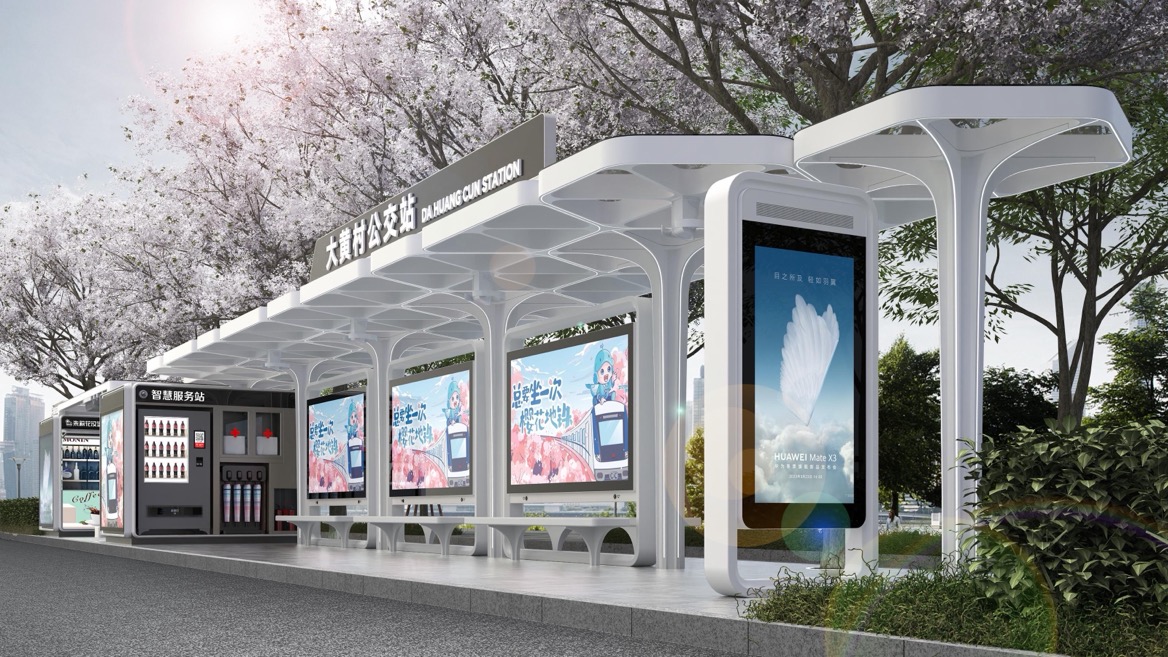
An ordinary solar shelter system should not be assumed capable of bus charging. Vehicle charging requires much greater electrical capacity and dedicated infrastructure. Any proposed integration needs a separate feasibility study.
No. In this article, the term describes a grid-powered passenger shelter. It can serve routes operated by diesel, electric, or mixed fleets.
Yes, when appropriately sized batteries or another supply power nighttime loads. Runtime depends on stored usable energy, consumption, weather, and control settings.
There is no universal answer. Solar systems introduce battery and photovoltaic maintenance, while grid-powered systems still require electrical inspections and equipment servicing. Compare complete configurations and local service costs.
Potentially, but screen consumption can dominate the energy budget. Confirm actual power demand, brightness settings, operating hours, and seasonal generation before promising off-grid operation.
Accessible design, durable construction, serviceable equipment, documented electrical capacity, and practical upgrade routes matter more than simply adding connected features.
- [International Energy Agency — Global EV Outlook 2026: Trends in Other EV Modes]. Source for 2025 electric-bus sales and battery-electric sales share. [iea]
- [US Department of Energy — Deploying Charging Infrastructure for Electric Transit Buses]. Source for illustrative charging-power ranges and charging-strategy considerations; these are guide values, not universal specifications. [afdc.energy]
- [US Department of Transportation — Planning for Electric Buses]. Supports route, schedule, utility, depot, climate, and infrastructure planning considerations. [transportation]
- [US Access Board — Accessibility Standards, Chapter 8]. Source for US boarding-area dimensions and shelter accessibility requirements. [access-board]
- [PVWatts Calculator — Solar Resource Data and System Losses]. Supports consideration of shading and system losses. PVWatts is not, by itself, a complete off-grid battery-autonomy design method. [pvwatts.nlr]
- [US Department of Energy — Solar Rooftop Potential]. Explains the use of PVWatts for estimating grid-connected photovoltaic production. [energy]


