
Email: ainlbusshelter@gmail.com | WhatsApp: +86-18800607527
Views: 243 Author: Ainl Bus Shelter Publish Time: 2026-10-18 Origin: Site


Content Menu
● Smart Bus Shelter vs IoT Bus Shelter: Understanding the Difference
>> What Is a Smart Bus Shelter?
>> What Is an IoT Bus Shelter?
● Smart Bus Shelter vs IoT Bus Shelter: Side-by-Side Comparison
● Which Technology Better Supports Urban Management?
>> Passenger Information: Data Quality Matters More Than Screen Size
>> Maintenance: Turn Equipment Alerts into Assigned Work
>> Safety and Accessibility: Preserve the Physical Essentials
>> Advertising: Separate Commercial and Public-Service Priorities
● Solar Smart Bus Shelters: Compare the Energy Budget, Not the Label
● Industry Case Study: Singapore Shows Why Operating Costs Matter
● A Practical Acceptance Test for Connected Bus Shelters
● Cybersecurity and Data Ownership: Specify Them Before Purchase
● Total Cost of Ownership: Which Shelter Offers Better Value?
● How to Choose the Right Smart Bus Shelter Configuration
>> Choose Passenger-Focused Upgrades When Needs Are Basic
>> Choose IoT Integration When Distributed Operations Need Visibility
>> Use a Phased Rollout for Mixed Urban Networks
● How Ainl Supports Customized Shelter Projects
>> Is an IoT Bus Shelter Better Than a Smart Bus Shelter?
>> Can an Existing Bus Shelter Be Upgraded with IoT Technology?
>> Does a Smart Bus Shelter Need an Internet Connection?
>> Can Solar Panels Power All Shelter Equipment?
>> Does Remote Monitoring Eliminate On-Site Maintenance?
>> What Should Cities Request Before Placing an Order?
A Smart Bus Shelter improves the passenger experience, while an IoT Bus Shelter emphasizes connected monitoring and operational control. For urban management, the strongest solution usually combines both: a durable, accessible shelter supported by reliable information, remote diagnostics, and practical maintenance workflows.
However, these are not competing, standardized product categories. A smart shelter can already include Internet of Things technology. The real purchasing question is therefore not which label sounds more advanced, but integration: how effectively the shelter connects passenger services, physical infrastructure, and municipal operations.
From a manufacturing and project-planning perspective, I would evaluate the proposed system against the problems a city needs to solve—not its number of screens or sensors.

A Smart Bus Shelter is a passenger-oriented public facility that combines weather protection with selected digital, energy, and convenience features.
Depending on the project, these may include:
- Real-time bus arrival displays.
- LED lighting and digital advertising.
- Accessible seating and route information.
- Solar panels and battery storage.
- Emergency communication or charging facilities.
Some functions operate locally. Others require connections to transit systems or management platforms. A shelter does not need every available feature to deliver meaningful value.
An IoT Bus Shelter uses connected devices to collect information, report equipment conditions, or support authorized remote commands.
Its architecture may include sensors, controllers, communication gateways, and a management platform. Applications can include lighting-status monitoring, cabinet-temperature alerts, energy measurement, and battery diagnostics.
The distinction is emphasis: "smart" describes improved services and capabilities; "IoT" describes an enabling connectivity architecture. A successful installation often belongs to both categories.
The table below compares common project emphases, not mandatory product definitions.
| Evaluation area | Passenger-focused smart shelter | IoT-integrated shelter |
|---|---|---|
| Primary objective | Improve comfort and information | Improve operational visibility and control |
| Typical features | Arrival displays, lighting, seating, advertising | Telemetry, alerts, remote settings, equipment monitoring |
| Connectivity | Required for selected services | Central to connected functions |
| Maintenance | May rely on inspections and reported faults | Can supplement inspections with condition alerts |
| Data requirements | Transit feeds and content schedules | Device identities, telemetry, permissions, retention rules |
| Main procurement risk | Buying attractive but underused features | Collecting data without actionable workflows |
| Best application | Passenger-facing upgrades | Distributed assets requiring coordinated management |
Neither approach guarantees lower costs or better service. Results depend on engineering, integration, maintenance capacity, and the quality of operational data.
A digital arrival display helps only when its information is reliable.
GTFS Realtime supports information such as trip updates, vehicle positions, and service alerts. Its published best practices recommend refreshing feeds at least every 30 seconds, or more frequently when the represented information changes. They also recommend that Trip Updates and Vehicle Positions contain data no older than 90 seconds.
These are feed recommendations, not a guarantee of arrival-prediction accuracy.
For procurement, specify:
- The source and permitted use of transit data.
- How stop identifiers match the shelter location.
- How stale information is detected.
- What passengers see when live data becomes unavailable.
A clearly labeled timetable is preferable to a frozen countdown presented as live information.
IoT integration can give maintenance teams visibility into faults before passengers report them. However, remote monitoring is not automatically predictive maintenance.
A controller may report that a display has disconnected. It may not identify whether the cause is a failed power supply, damaged cable, or mobile-network interruption.
Useful monitoring therefore needs an operational chain:
1. Detect a meaningful event.
2. Classify its urgency.
3. Notify the responsible team.
4. Create or update a work order.
5. Confirm restoration after repair.
My procurement rule is simple: every proposed alert should have a named owner and an agreed response.
Connectivity cannot compensate for poor shelter design.
Cities should first address clear pedestrian routes, boarding access, seating, drainage, lighting, and visibility of approaching buses. Digital equipment must not obstruct these functions.
Emergency buttons also require more than installation. Buyers should establish who answers, how the location is identified, and what happens if communications fail.
Similarly, occupancy monitoring does not necessarily require identifying individuals. Where aggregate counts meet the objective, consider less intrusive sensing and define data-retention requirements before deployment.
Both shelter configurations can accommodate digital advertising.
Connected content management may simplify scheduling, but advertising revenue should not be assumed. It depends on location, permissions, audience, commercial agreements, and operating costs.
For municipal projects, specify which messages take priority. Service disruptions and emergency notices should not compete ambiguously with commercial content.
Public Wi-Fi, advertising systems, and operational controls should also have clearly separated access permissions and appropriate network boundaries.
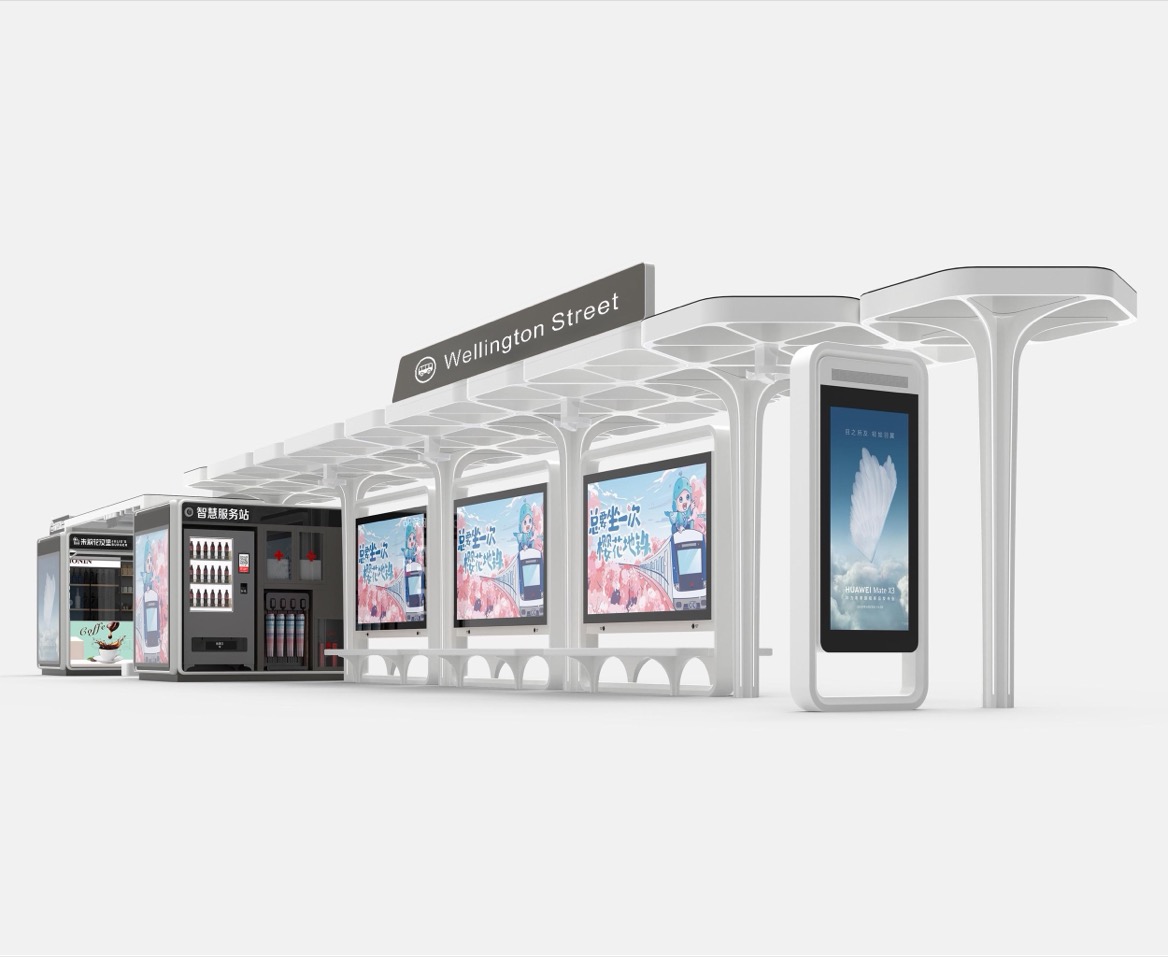
Solar power can support either a Smart Bus Shelter or an IoT Bus Shelter. Connectivity itself does not determine whether an installation can operate off-grid.
Begin with a load schedule covering:
- Display power and operating hours.
- Lighting demand.
- Gateway and controller consumption.
- Sensors, charging outlets, and auxiliary equipment.
- Conversion losses and battery reserve.
Then assess shading, seasonal solar availability, battery temperature, and the required autonomy during poor weather.
A shelter using low-power information displays may have a very different energy requirement from one running large illuminated advertising screens.
Ask suppliers for a site-specific energy balance and load-priority plan. During a low-battery event, nonessential services should not consume energy needed for agreed critical functions.
Singapore's Airbitat Oasis Smart Bus Stop illustrates both the possibilities and limitations of feature-rich infrastructure.
The trial combined cooling technology with sensors monitoring conditions such as temperature, air pollution, and commuter traffic. The cooling arrangement was redesigned after feedback to improve effectiveness and operating efficiency.
However, Singapore's Land Transport Authority reported that high operation and maintenance costs compared with a typical bus stop led to the trial ending in August 2021.
The lesson is not that advanced shelters fail. It is that a successful demonstration does not automatically justify network-wide deployment.
Before scaling, test whether users value the feature enough to support its energy, servicing, cleaning, and replacement requirements.
A product demonstration usually shows normal operation. Urban management also requires evidence of how the system behaves when something goes wrong.
For a pilot, I would include five witnessed tests:
1. Disconnect the network and verify the agreed passenger-information fallback.
2. Interrupt a monitored component and confirm that the correct alert reaches the responsible operator.
3. Send outdated transit data and check that the display does not present it as current.
4. Restore power and verify safe, controlled recovery.
5. Export asset records and maintenance data in the agreed format.
Record expected results, actual results, and corrective actions.
These tests expose integration gaps that a feature checklist may miss. They also make supplier comparisons more objective because each bidder must demonstrate the same operational outcomes.
Every connected device introduces responsibilities for access, updates, and support.
NIST's IoT Device Cybersecurity Capability Core Baseline provides a starting point for evaluating device capabilities. It is guidance, not a product certification.
Translate security expectations into contractual requirements:
- Unique device identification.
- Authorized configuration changes.
- Protection of stored and transmitted data.
- Restricted access to interfaces.
- Secure, authorized software updates.
- Visibility into relevant security conditions.
Also clarify who owns operational data, where it is hosted, and how it can be exported.
Ask how credentials are transferred at handover, how long updates remain available, and what happens when a connectivity or software contract ends. These details affect whether a city can continue operating its assets independently.
Purchase price alone provides an incomplete comparison.
For an agreed evaluation period, include:
| Cost category | Items to assess |
|---|---|
| Initial delivery | Structure, electronics, foundations, installation, commissioning |
| Integration | Transit feeds, interfaces, platform configuration, testing |
| Recurring operation | Electricity, connectivity, software, cleaning, support |
| Maintenance | Inspections, replacement parts, field labor, battery renewal |
| End of life | Removal, disposal, data migration, replacement planning |
An IoT-integrated shelter may reduce some diagnostic visits, but that benefit must be tested against connectivity fees, platform charges, and added component maintenance.
Compare proposals using the same service requirements and assumptions. Keep potential advertising income separate from guaranteed savings, and examine what happens if revenue falls below expectations.
For stops with limited service requirements, prioritize weather protection, accessible layouts, durable finishes, lighting, and readable information.
Avoid adding connected features simply because they are available. Each component introduces support obligations.
Connected monitoring becomes more relevant when teams manage many locations, travel significant distances, or need centralized equipment status.
Start with a defined problem—such as repeated lighting outages—rather than an unrestricted sensor list.
Different stops may justify different configurations.
A practical approach is to establish a common structural platform, then add information displays, energy systems, and monitoring packages according to site needs.
Pilot representative locations before expansion. Measure equipment availability, repair time, information freshness, energy use, and passenger feedback. Agree how each indicator is calculated so performance remains comparable.
Ainl is a Chinese manufacturer and solutions provider with 16 years of experience in smart-city public facilities and outdoor advertising products.
According to its company-provided profile, Ainl is a National High-Tech Enterprise occupying more than 260 mu, with approximately 150,000 square meters of factory space. Its facilities include provincial-level hardware and software research capabilities, precision CNC sheet-metal processing, large-scale coating, and electrical testing.
Ainl also reports relevant Grade III contracting qualifications, management-system certifications, and Grade III work-safety standardization certification. Buyers should review current documents and their applicability to the destination project.
Its OEM/ODM scope covers dimensions, structures, colors, displays, lighting, solar solutions, and city-branding elements.
For an actionable proposal, send Ainl your site drawings, climate conditions, passenger-service requirements, preferred data interfaces, power availability, and maintenance expectations. Request a configuration matrix, preliminary energy assessment, integration scope, and lifecycle support proposal—not just a product quotation.
Not inherently. IoT describes connected capabilities, while smart shelters describe broader service improvements. The better configuration is the one that meets defined passenger and operational needs reliably.
Potentially. A retrofit assessment should check structural condition, mounting space, electrical capacity, weather protection, communications coverage, and maintenance access before selecting devices.
Not for every function. Basic lighting and locally stored content can operate without continuous internet access. Live arrivals, remote updates, and centralized monitoring normally require a suitable connection.
Only if the site-specific energy assessment supports it. Display demand, operating hours, shading, seasonal sunlight, battery capacity, and required backup duration determine feasibility.
No. It can support fault detection and diagnosis, but cleaning, structural inspection, drainage checks, vandalism repair, and component replacement still require physical work.
Request drawings, material and finish specifications, electrical documentation, integration responsibilities, security provisions, acceptance tests, spare-parts arrangements, warranty terms, and a clearly defined support period.
1. Land Transport Authority, Singapore. "[What's the Latest Buzz On Our Bus Stop Shelters?]" Published April 26, 2024. Supports the Singapore case study, including the cooling-system redesign and the operating-cost reason for ending the trial. [lta.gov]
2. GTFS.org. "[GTFS Realtime Best Practices]." Technical guidance supporting the feed-refresh and data-age recommendations discussed in the passenger-information section. [gtfs]
3. GTFS.org. "[GTFS Realtime Reference]." Describes the information represented by real-time transit feeds, including service disruptions, vehicle locations, and expected arrivals. [gtfs]
4. Fagan, Michael; Megas, Katerina N.; Scarfone, Karen; and Smith, Matthew. "[IoT Device Cybersecurity Capability Core Baseline]." National Institute of Standards and Technology, NISTIR 8259A, May 29, 2020. Provides the foundational device-security guidance informing the procurement checklist. [nist]
5. National Institute of Standards and Technology. "[NISTIR 8259 Series]." Explains the relationship between technical device capabilities and supporting manufacturer activities. [nist]


