
Email: ainlbusshelter@gmail.com | WhatsApp: +86-18800607527
Views: 231 Author: Ainl Bus Shelter Publish Time: 2026-11-27 Origin: Site


Content Menu
● Outdoor LCD Display vs. Bus Shelter Advertising Display: What Is the Difference?
>> What Is an Outdoor LCD Display?
>> What Is a Bus Shelter Advertising Display?
● Side-by-Side Comparison for Transit Projects
● Advertising Visibility and Passenger Experience
>> Outdoor LCD Displays Offer Flexible Placement
>> Bus Shelter Displays Connect Advertising With Waiting Areas
● Outdoor LCD Display Performance: Brightness Is Only the Beginning
>> Evaluate Sunlight Readability as a Complete System
>> Match Resolution and Content to Viewing Distance
● Weather Protection, Structural Safety, and Accessibility
>> Specify Protection for the Delivered Assembly
>> Preserve Accessible Passenger Space
● Installation and Maintenance: Where Project Complexity Appears
>> Standalone Displays Can Simplify Targeted Upgrades
>> Integrated Shelters Require Coordinated Engineering
● Total Cost of Ownership: Compare Equivalent Scopes
● Three Procurement Checks That Improve Project Decisions
>> 1. Run a Representative Pilot Before Network Deployment
>> 2. Separate Playback Records From Audience Measurement
>> 3. Validate Solar Power Against the Full Energy Load
● Which Public Transit Advertising Solution Should You Choose?
● How Ainl Supports Customized Transit Advertising Projects
>> Can an Outdoor LCD Display Be Installed in a Bus Shelter?
>> Are All Bus Shelter Advertising Displays Digital?
>> Is a Shelter Roof Enough to Protect an LCD Screen?
>> Can One Display Show Advertising and Live Bus Information?
>> Can Solar Panels Power a Digital Advertising Shelter?
An outdoor LCD display is usually the better choice when you need a dedicated digital advertising unit at an existing transit location. A bus shelter advertising display is more suitable when advertising must be integrated with passenger shelter, seating, lighting, and streetscape design. However, these are not competing screen technologies: a bus shelter advertising display can itself use an outdoor LCD display.
For transit authorities, advertising operators, and contractors, this distinction changes the purchasing decision. The real comparison is often between a standalone digital installation and a shelter-integrated advertising solution.
At Ainl, our manufacturing-led approach starts with the site, passenger needs, and maintenance requirements—not simply screen size. This guide compares both options and provides a practical framework for specifying public transit advertising infrastructure.
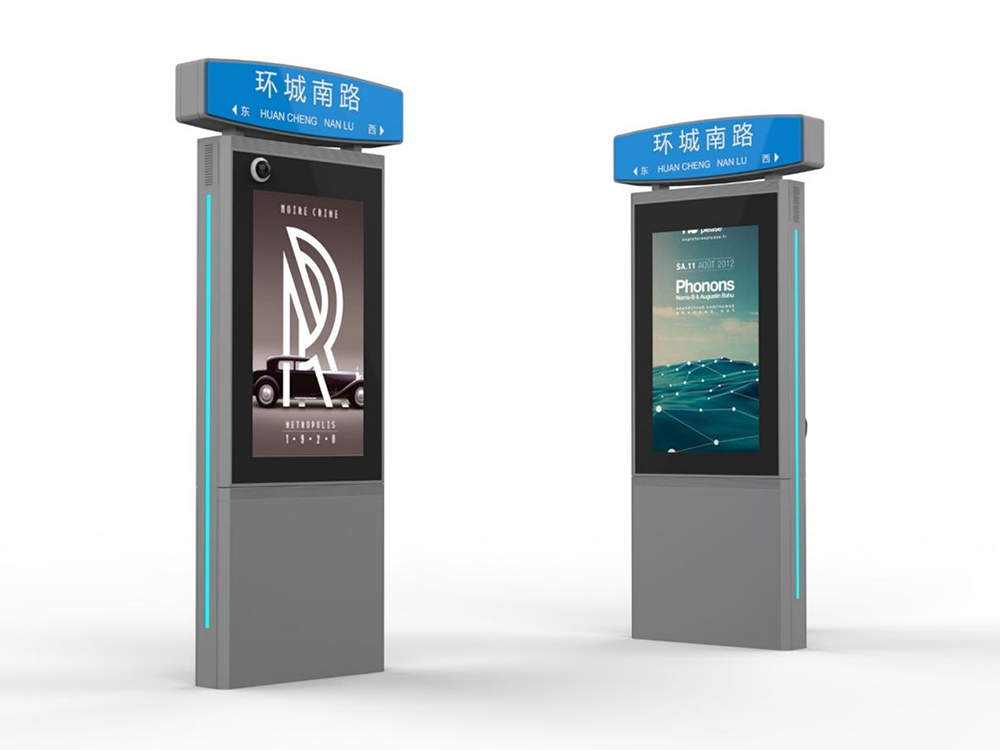
An outdoor LCD display uses a liquid crystal panel and backlight to present digital content. A complete outdoor installation also requires appropriate protective glass, an enclosure, thermal management, electrical protection, and mounting hardware.
Common applications include:
- Freestanding advertising kiosks near transit stations.
- Digital information totems at interchange entrances.
- Wall-mounted screens in outdoor passenger areas.
- Advertising displays installed inside bus shelter structures.
Its defining characteristic is the display technology, not its location or supporting structure.
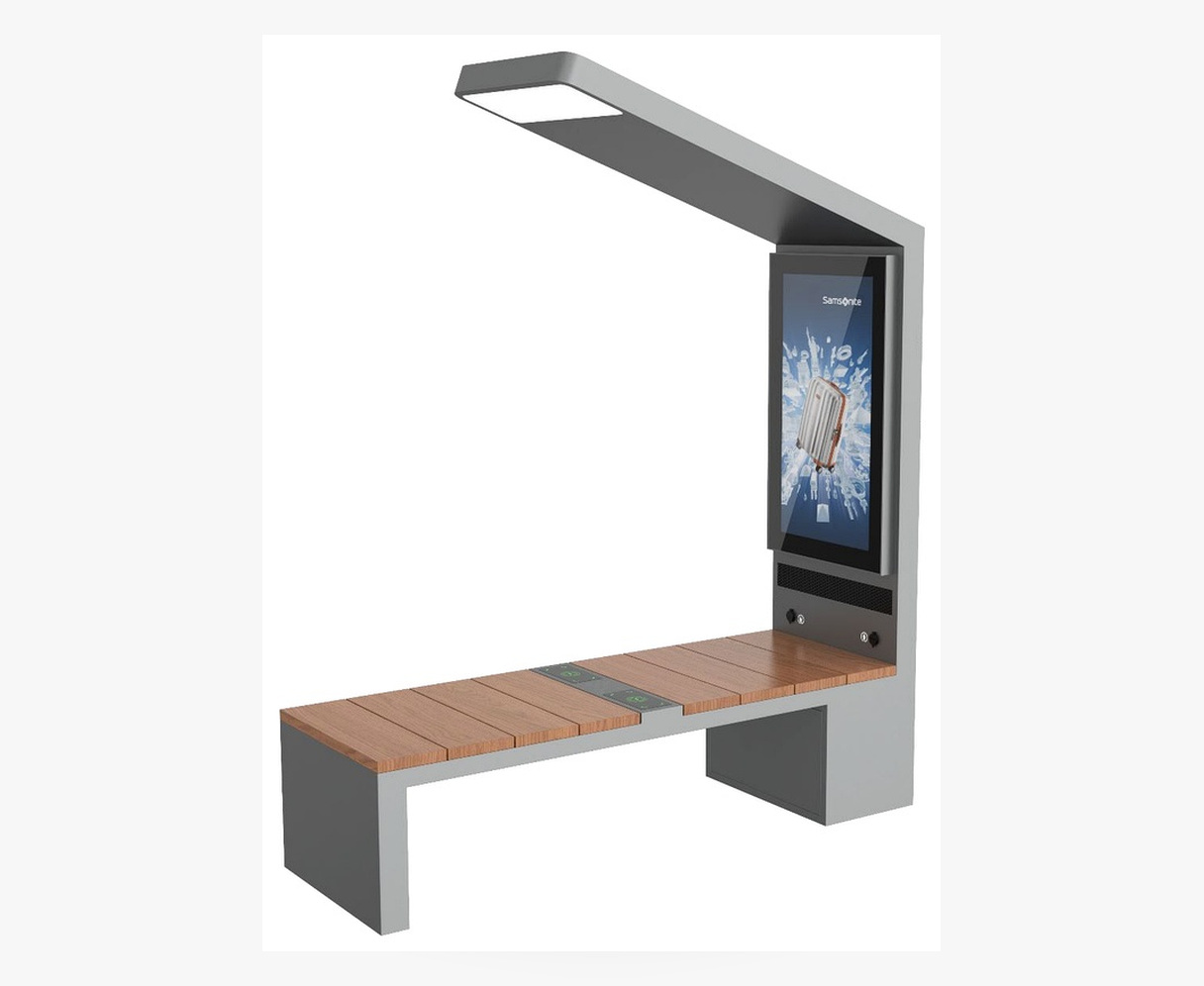
A bus shelter advertising display is an advertising surface incorporated into, attached to, or designed around a passenger shelter.
It may use a printed poster, illuminated lightbox, outdoor LCD panel, or direct-view LED screen. Consequently, not every bus shelter advertising display supports video, remote updates, or interactive functions.
For a meaningful comparison, buyers should distinguish between:
1. A standalone outdoor LCD advertising unit.
2. A digital advertising display integrated into a bus shelter.
3. A conventional poster-based shelter advertising panel.
This article primarily compares the first two while identifying where static advertising remains relevant.
| Selection factor | Standalone outdoor LCD display | Shelter-integrated advertising display |
|---|---|---|
| Primary purpose | Dedicated digital communication and advertising | Advertising combined with passenger infrastructure |
| Display technology | LCD | LCD, LED, or printed advertising |
| Location flexibility | Can serve station entrances, plazas, and suitable sidewalks | Position depends on shelter layout and transit requirements |
| Passenger amenities | Usually separate from the display | Can integrate roofing, seating, lighting, and information |
| Digital content | Remote updates when connected to a suitable platform | Available when a digital screen and platform are specified |
| Installation scope | Foundations, power, communications, and mounting | May also include shelter structure, drainage, roofing, and seating |
| Maintenance planning | Access around a dedicated cabinet | Access must account for shelter users and structural components |
| Best-fit project | Targeted digital upgrades | New shelters or coordinated transit-stop improvements |
The central procurement question is therefore project scope: are you buying advertising equipment, upgrading an existing shelter, or delivering a complete passenger facility?
A standalone outdoor LCD display can be positioned independently of shelter rooflines and seating arrangements, subject to permits, available space, and accessibility requirements.
This flexibility can help advertisers address pedestrians approaching a station rather than only passengers already waiting at a stop.
However, a prominent position does not automatically create a strong advertising location. Trees, parked vehicles, queues, reflections, and viewing angles can all reduce visibility.
Our recommendation is to evaluate the actual approach routes before selecting cabinet orientation or screen dimensions.
A shelter-integrated display places advertising within the passenger waiting environment. It can also contribute to a coordinated appearance across a transit network.
Yet waiting time should not be treated as guaranteed advertising attention. Passengers may face approaching buses, check their phones, or stand outside the shelter.
For either installation, assess:
- Pedestrian approach directions.
- Typical standing and seated viewing positions.
- Obstructions during peak periods.
- Visibility of approaching buses.
- Separation between advertising and essential transit information.
The strongest layout supports passenger movement and makes the message easy to notice without overwhelming the stop.

Outdoor LCD specifications should be assessed against actual exposure conditions.
As a market reference, Samsung lists approximately 3,500-nit typical brightness, automatic brightness adjustment, and anti-reflection features for its OH55A outdoor display. These are model-specific specifications, not universal requirements or specifications for Ainl products.
A procurement specification should also address:
- Reflections from the protective glass.
- Viewing angle and screen orientation.
- Readability through polarized sunglasses.
- Performance under direct solar loading.
- Automatic dimming after dark.
- Temperature limits for the complete assembly.
A shelter roof may reduce some exposure, but it does not automatically protect a screen from low-angle sunlight or reflected heat.
LCD can be a suitable choice for detailed transit messages, maps, and close-range advertising. However, resolution alone cannot compensate for small lettering or cluttered layouts.
Test sample content at the intended viewing distance. Include promotional messages, service notices, and emergency information.
For digital bus shelter advertising, keep commercial content visually distinct from passenger information. Advertising should not make essential route details harder to identify.
IP ratings describe enclosure protection against ingress. IK ratings address mechanical impact resistance. Neither establishes complete suitability for every outdoor installation.
For example, Samsung identifies IP56 and IK10 protection for the referenced outdoor display. Integrating that display into a larger cabinet still requires attention to cable entries, ventilation, drainage, seals, and service doors.
Request evidence covering the supplied configuration, not merely one component.
Depending on the site, the project may also require assessment of corrosion exposure, wind loads, foundations, electrical safety, and water accumulation.
A shelter-integrated display must not consume space needed by passengers with mobility aids or obstruct the route to boarding.
For U.S. projects, the applicable accessibility standards include requirements for clear floor space within bus shelters and an accessible connection to the boarding and alighting area. Other destinations require review against their own regulations.
From a design perspective, check the entire installation—including open maintenance doors, projecting cabinets, and foundation details—not just its appearance in a rendering.
When suitable shelter infrastructure already exists, a standalone outdoor LCD display may avoid replacing the passenger facility.
Nevertheless, the installation still needs coordinated foundations, utility connections, communications, permissions, and safe access.
Before ordering, confirm:
- Underground service locations.
- Available electrical capacity.
- Communications coverage.
- Lifting and delivery access.
- Maintenance working space.
- Responsibility for civil and electrical works.
A lower equipment price can lose its advantage if these items are omitted from the quotation.
A digital bus shelter combines multiple systems within a limited footprint.
The screen must coexist with structural members, drainage paths, lighting, seating, wiring, and access panels. Maintenance staff should be able to replace serviceable components without unnecessary dismantling.
In our view, service access deserves early design approval. Attractive cladding provides little operational value if a routine repair requires removing major shelter components.
Ask suppliers to show component replacement procedures before production begins.
A standalone screen and a complete advertising shelter should not be compared using purchase price alone.
A useful ownership model includes:
> Equipment + civil works + installation + electricity + connectivity + software + maintenance + replacement parts + end-of-life costs.
Compare quotations over the same operating period and include equivalent responsibilities.
| Cost category | Questions buyers should ask |
|---|---|
| Equipment | Does the price include the cabinet, player, mounting, and protective glass? |
| Site works | Who supplies foundations, trenching, reinstatement, and electrical connections? |
| Operation | What are the expected average power demand and software charges? |
| Maintenance | Which cleaning, inspection, and component replacement tasks are required? |
| Downtime | Who responds to failures, and which spare parts are locally available? |
For an illustrative calculation, a system averaging 0.45 kW over 18 operating hours daily would consume approximately 2,957 kWh annually. This is a planning example, not a measured Ainl product figure.
Use expected average consumption for the full installation, including cooling, lighting, and auxiliary equipment.
Rather than approving a network-wide rollout from showroom performance, test a representative installation.
A pilot acceptance checklist should include:
- Readability during the most difficult sunlight period.
- Nighttime brightness and nearby light spill.
- Passenger circulation and boarding visibility.
- Recovery after power or network interruption.
- Service-door access and component replacement.
- Temperature and moisture behavior.
Agree on acceptance criteria before testing. A pilot provides stronger decision evidence when "acceptable performance" has a defined meaning.
A content management system may record that an advertisement played. That does not establish how many people saw it.
Keep these measures separate:
- Playback delivery.
- Screen availability.
- Estimated audience exposure.
- Passenger information performance.
- Campaign response, where measurable.
Avoid assuming that a more expensive screen automatically generates higher advertising revenue. Location, advertising rights, occupancy, sales capability, and contract terms also influence commercial results.
Solar-assisted configurations can be considered, but roof area alone does not establish feasibility.
A high-brightness digital display requires an energy assessment covering seasonal solar availability, shading, batteries, operating hours, and supporting equipment.
Solar may be more practical for selected lighting or lower-power functions than for continuously operating a large digital screen.
For off-grid proposals, request an explicit energy balance and a plan for extended low-sunlight periods.
Choose a standalone outdoor LCD display when:
- Existing passenger shelter infrastructure remains suitable.
- Advertising placement needs to be independent of shelter geometry.
- The project focuses on a targeted digital upgrade.
- Dedicated maintenance access is available.
Choose a shelter-integrated advertising display when:
- The project includes new or replacement shelters.
- Advertising and passenger amenities require coordinated design.
- The city wants consistent street furniture across multiple stops.
- Structural, electrical, and display systems can be planned together.
A printed shelter advertising panel may remain appropriate where campaign changes are infrequent, digital operation is unnecessary, or infrastructure constraints make screens impractical.
Ainl's supplied company profile describes 16 years of experience developing, manufacturing, and supplying outdoor advertising displays and smart-city public facilities.
Our manufacturing resources include approximately 150,000 square meters of factory space, provincial-level software and hardware research facilities, precision sheet-metal processing, coating facilities, and an electrical testing laboratory.
For buyers, the practical value is the ability to coordinate the display enclosure with the wider public-facility design.
OEM/ODM requirements can cover dimensions, structural arrangements, colors, screen configuration, lighting, solar-assisted options, and municipal branding.
Project-specific drawings, test evidence, certifications, and destination requirements should still be reviewed before purchase.
Send Ainl your site photographs, shelter dimensions, installation location, power conditions, operating schedule, and advertising requirements. Request a side-by-side proposal for a standalone LCD unit and a shelter-integrated solution, including maintenance access and clearly itemized installation scope.
Yes. Outdoor LCD describes the screen technology, while bus shelter advertising display describes the application. Integration requires appropriate structural support, thermal management, electrical protection, and maintenance access.
No. Shelter advertising can use printed posters, illuminated lightboxes, LCD panels, or direct-view LED screens. Remote content updates require a suitable digital system.
It depends on scope. A dedicated display upgrade may cost less than replacing a complete shelter, but foundations, utilities, permissions, and long-term maintenance can change the comparison.
No. Wind-driven rain, reflected sunlight, heat, condensation, and airborne contaminants can still affect the installation. Specify an outdoor-suitable assembly for the actual site.
Yes, with compatible software, approved data access, and a defined layout. Essential passenger information should remain clear, with appropriate fallback content when connectivity fails.
Potentially, but feasibility depends on the complete energy load, available sunlight, battery capacity, and operating schedule. A project-specific assessment is necessary.
- Samsung, "Outdoor Signage OH55A." Manufacturer reference for the example brightness, automatic brightness adjustment, anti-reflection features, and IP56/IK10 protection. These specifications do not represent Ainl products. [samsung]
- U.S. Access Board, "Chapter 8: Special Rooms, Spaces, and Elements," Section 810.3. Primary source for the cited U.S. bus shelter accessibility requirements. [access-board]
- U.S. Access Board, "ADA Accessibility Standards," Section 305. Source for clear floor space provisions referenced by the bus shelter requirements. [access-board]


