
Email: ainlbusshelter@gmail.com | WhatsApp: +86-18800607527
Views: 257 Author: Ainl Bus Shelter Publish Time: 2026-11-18 Origin: Site


Content Menu
● Outdoor LED vs. LCD Advertising Displays: Quick Comparison
● How Outdoor LED and LCD Displays Work
>> Direct-View LED: A Modular, Light-Emitting Surface
>> Outdoor LCD: A Backlit Panel Within an Engineered System
● Brightness and Sunlight Readability: Compare More Than Nits
>> Why Reflections and Orientation Matter
● Resolution, Pixel Pitch, and Viewing Distance
>> A Practical LED Resolution Example
● Touch Interaction and Content Requirements
● Outdoor Durability: Specify the Complete Assembly
>> Separate Environmental Protection From Structural Safety
● Energy Consumption and Five-Year Ownership Cost
>> Compare Systems Under Equivalent Conditions
● Maintenance, Lifespan, and Repairability
● Three Project Scenarios: Matching Technology to the Task
>> Roadside Advertising With Brief Viewing Time
>> A Pedestrian Kiosk With Maps and Touch Functions
>> A Bus Shelter Combining Advertising and Passenger Information
● OEM/ODM Customization: Look Beyond Screen Dimensions
● A Five-Step Outdoor Advertising Screen Selection Process
>> Is LED or LCD better for outdoor advertising?
>> Can LCD advertising displays operate in direct sunlight?
>> Are outdoor LED screens always cheaper to operate?
>> What LED pixel pitch should I choose?
>> Can outdoor LCD displays adjust brightness automatically?
>> Can Ainl customize outdoor LED and LCD display structures?
Choosing between outdoor LED and LCD advertising displays starts with a practical question: what must your audience see, from where, and under which conditions? A roadside billboard, an interactive city kiosk, and a bus shelter may all carry advertising, but they require different display solutions.
Direct-view LED generally suits large-format advertising viewed from a distance. Outdoor LCD often suits close-range information, detailed content, and interactive applications. Neither technology automatically delivers lower operating costs or greater durability; the complete system determines performance.
At Ainl, our approach is to evaluate the site, content, enclosure, and maintenance requirements together. This guide explains the differences and provides a practical framework for selecting an outdoor advertising screen.
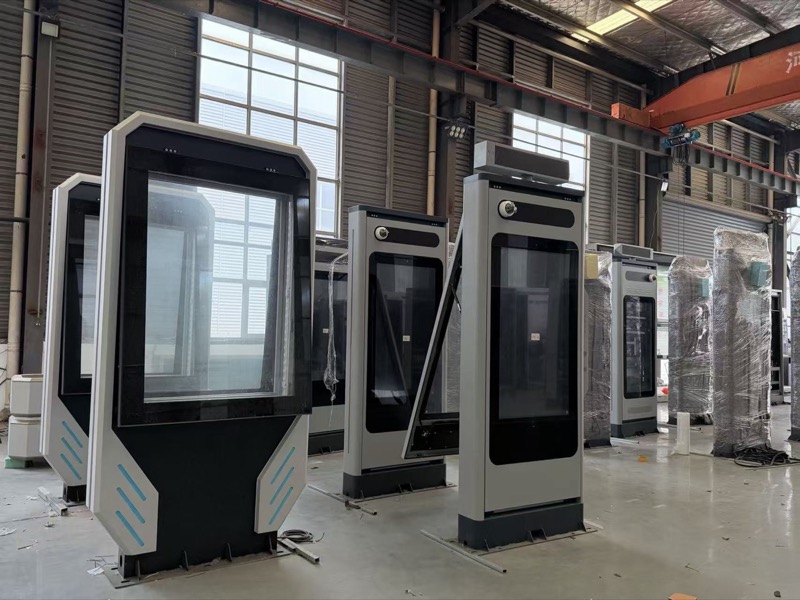
| Selection factor | Direct-view outdoor LED | Outdoor LCD |
|---|---|---|
| Image technology | LEDs emit light directly | Liquid crystals control light from a backlight |
| Strongest applications | Billboards, façades, large public displays | Kiosks, menu boards, bus shelters, wayfinding |
| Viewing distance | Flexible; pixel pitch determines close-viewing suitability | Often suitable for nearby viewers and detailed information |
| Screen dimensions | Modular construction supports large and unusual formats | Panel dimensions constrain the active display area |
| Sunlight visibility | High-output models provide substantial brightness | Purpose-built high-brightness models support outdoor visibility |
| Touch interaction | Possible, but requires application-specific integration | Commonly integrated into interactive kiosks |
| Maintenance | Individual modules and components may be replaceable | Panel, backlight, electronics, and cooling require service planning |
| Energy consumption | Depends on brightness, content, area, and system design | Depends on backlight settings, panel size, and thermal management |
The most useful comparison is between complete, application-matched systems—not an indoor LCD and an outdoor LED billboard.
A direct-view LED display creates images through light-emitting pixels arranged in modules. Cabinets combine these modules into a larger display.
This architecture supports scalable dimensions and flexible proportions. It also makes pixel pitch a central purchasing decision.
Pixel pitch is the distance between adjacent pixel centers. A smaller pitch places more pixels within a given area, increasing resolution but generally increasing cost.
An LCD uses liquid crystals to control light from a backlight, commonly an LED backlight.
This distinction matters: an "LED-backlit LCD" is still an LCD, not a direct-view LED display.
For outdoor use, the panel must work with suitable protective glass, thermal management, environmental sealing, and brightness control. A standard indoor monitor inside a metal cabinet is not automatically an outdoor-ready product.
Brightness is measured in nits, equivalent to candelas per square meter. However, a larger number does not guarantee better readability at every site.
Daktronics lists calibrated brightness of 6,000–10,000 nits for its outdoor LED video displays, depending on configuration. Samsung specifies 3,500-nit typical brightness for its OH55A-S outdoor LCD, with automatic brightness adjustment.
These are manufacturer-specific examples, not universal thresholds or Ainl product specifications.
A high-brightness outdoor LCD can still become difficult to read if protective glass reflects the surrounding environment. Similarly, an LED display can become uncomfortable after sunset if brightness remains excessive.
Evaluate:
- Direct sunlight at the hottest operating period.
- Reflections from nearby buildings and vehicles.
- Glass treatments and finished-assembly light transmission.
- Visibility through polarized sunglasses.
- Automatic dimming and nighttime settings.
Our recommendation is to test representative content at the actual viewing position. A shaded showroom demonstration cannot establish afternoon street-level readability.
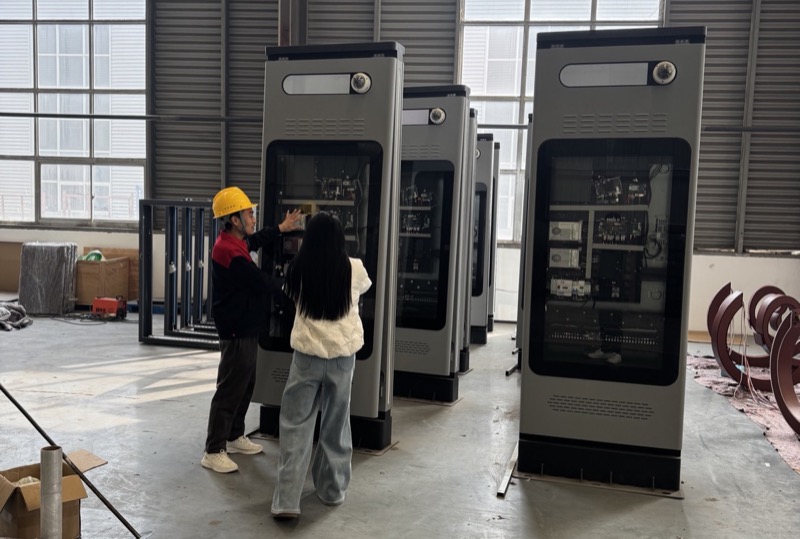
LCD is often attractive for nearby audiences reading maps, menus, transport information, or multilingual instructions.
Direct-view LED becomes particularly compelling when the advertising area must be large. However, the intended viewing distance should guide pixel pitch.
Consider a proposed LED screen measuring approximately four meters wide by two meters high.
At 4 mm pixel pitch, its nominal resolution is approximately 1,000 × 500 pixels. At 8 mm pitch, it is approximately 500 × 250 pixels. Actual dimensions depend on available modules and cabinets.
Both screens occupy the same physical area, but they cannot reproduce the same amount of detail.
For a useful specification review:
1. Identify the nearest meaningful viewing position.
2. Select representative advertisements and information screens.
3. Check the smallest essential text.
4. Test actual content on the proposed resolution.
Do not purchase a finer pitch simply because it sounds premium. Purchase enough resolution to make the intended message legible.
For interactive outdoor digital signage, LCD is often the more straightforward starting point.
Its dense pixel structure and familiar panel formats suit maps, directories, product information, and touch-based workflows. Nevertheless, touch performance depends on the integrated touch system—not merely the display technology.
An outdoor kiosk specification should address wet-weather behavior, protective-glass thickness, glove requirements, interface size, and accessible placement.
Direct-view LED can also support interaction through additional technologies. For many large advertising installations, however, mobile interaction or QR-based engagement may be more practical than touching the screen.
A useful distinction is whether the audience must glance, read, or interact. Those behaviors create different hardware requirements.
Neither LED nor LCD is inherently weatherproof.
Reliability depends on the enclosure, seals, connectors, ventilation, coatings, installation, and maintenance. Samsung's OH55A-S, for example, specifies IP56 ingress protection and IK10 impact resistance. Those ratings apply to that product, not to outdoor LCD technology generally.
For each proposed display, request documentation covering:
- Ingress protection for the relevant enclosure surfaces.
- Impact resistance where public contact is likely.
- Operating temperature and humidity limits.
- Condensation prevention and drainage.
- Corrosion protection for coastal or industrial locations.
- Wind-load calculations, foundations, and anchoring.
- Electrical protection and grounding requirements.
An IP rating does not establish resistance to every outdoor hazard. It does not replace structural engineering, corrosion assessment, or destination-market compliance.
Thermal performance also deserves separate review. Ask whether stated temperature limits apply under direct solar exposure and at the intended operating brightness.
The claim that LED is always more energy-efficient than LCD is too broad.
LED consumption varies with brightness, content, display area, and electronics. LCD consumption depends heavily on its backlight and also on system controls and thermal management. Both technologies can support automatic brightness adjustment.
Request average and maximum power figures, but ask how each was measured.
A useful comparison holds these conditions consistent:
- Required readable advertising area.
- Operating hours and brightness schedule.
- Representative content.
- Ambient temperature.
- Included fans, heaters, cooling, and media players.
For budgeting:
Annual energy cost=Average system power in kW×Annual operating hours×Electricity tariff
Then calculate five-year ownership cost by adding equipment, installation, electricity, connectivity, scheduled maintenance, spare parts, and expected repair access costs.
For an elevated screen, access equipment and traffic management can materially change the maintenance budget. A lower purchase price is not necessarily a lower project cost.
Be cautious when comparing advertised operating-hour claims. LED component life, LCD backlight life, and complete-system service life are different measures.
Ask what a lifespan figure means. Does it describe reduced brightness, component survival, or a warranty commitment? Under which temperature and operating conditions?
For LED, evaluate module availability, calibration procedures, power-supply access, and color matching after replacement.
For LCD, examine panel availability, protective-glass replacement, cooling maintenance, and access to internal electronics.
For either technology, establish:
- Front or rear service access.
- Spare-parts availability and storage recommendations.
- Warranty exclusions and claim procedures.
- Remote fault monitoring.
- Expected repair responsibilities.
Repairability matters most when it is designed into the installation before production.
The following are illustrative selection scenarios, not reported Ainl installations.
For a large-format screen aimed at passing traffic, direct-view LED is usually a strong candidate.
The priorities are visibility, message simplicity, appropriate pixel pitch, structural safety, and locally permitted brightness and content behavior. Fine text and complicated layouts are poor substitutes for a clear message.
Outdoor LCD is often a practical starting point for a close-viewing kiosk.
Priorities shift toward fine detail, touch usability, reflection control, vandal resistance, and accessible servicing. A high-resolution panel still needs well-designed interface elements to remain usable outdoors.
Either technology may work.
LCD can suit nearby viewers reading detailed arrival information. LED may suit a larger advertising surface targeting viewers farther away. Where both functions are required, separate display zones may work better than forcing one screen to serve incompatible viewing needs.
For smart-city infrastructure, the screen is one component of a larger public-facing product.
Ainl's company profile describes 16 years of experience in outdoor advertising displays and public facilities, supported by approximately 150,000 square meters of factory space across a site exceeding 260 mu.
Its stated capabilities include provincial-level hardware and software development facilities, CNC sheet-metal processing, large-scale coating, and electrical testing.
These resources support coordinated customization of:
- Product dimensions and enclosure structure.
- Colors, finishes, and city identity elements.
- Screen configuration and lighting.
- Service doors and equipment integration.
- Solar-power options where technically feasible.
Solar supply requires particular care. Size it against the measured system load, operating schedule, local solar resource, battery requirements, and backup strategy. A small panel does not make a high-power display energy-independent.
Ainl also reports national high-tech enterprise status and relevant construction, management-system, and safety credentials. Buyers should request current documentation and verify applicability to their project and destination market.
Before requesting a final quotation:
1. Define the audience, message, viewing distance, and interaction requirements.
2. Document orientation, sunlight, temperature, environmental exposure, and power availability.
3. Compare actual content on the proposed display resolution and brightness settings.
4. Review drawings, service access, test documentation, and lifecycle costs.
5. Agree on acceptance criteria covering visibility, controls, environmental performance, and maintainability.
For an application-specific proposal, send Ainl your site photographs, installation location, target dimensions, viewing distances, operating schedule, and customization requirements. Request an LED-versus-LCD recommendation with a proposed structure, screen configuration, and maintenance plan—not simply a unit price.
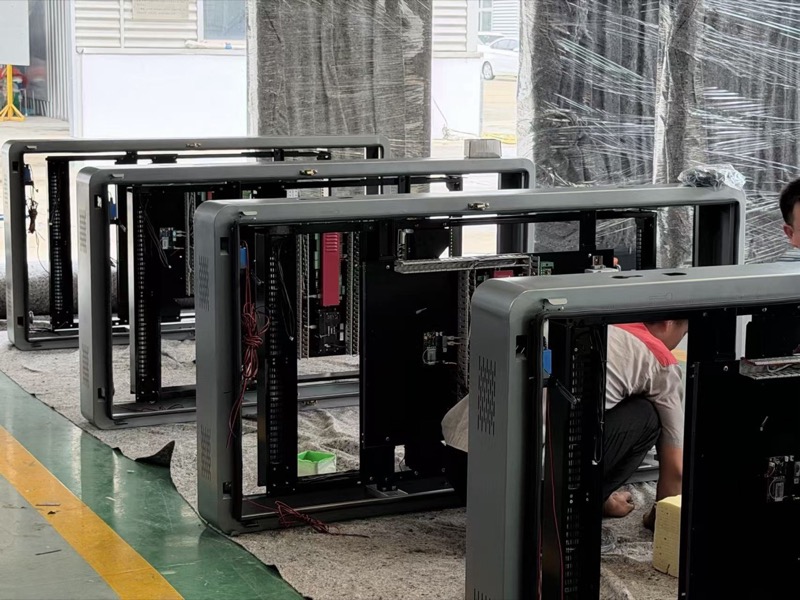
LED generally suits large-format advertising and longer viewing distances. Outdoor LCD often suits close-range information and interactive applications. Site conditions and content should determine the final choice.
Purpose-built outdoor LCDs can support sunlight-readable operation. Confirm brightness, reflection control, solar-load performance, and installation requirements for the selected model rather than relying on an "outdoor" label.
No. Compare complete-system consumption under equivalent conditions. Display size, brightness schedules, content, cooling, operating hours, and service access all influence ownership cost.
Choose pitch according to viewing distance, screen dimensions, and content detail. Test the smallest essential text at the proposed resolution rather than relying on a single distance-to-pitch rule.
Yes. Some outdoor LCD products include ambient-light sensors and automatic brightness control. Specify the required adjustment behavior and confirm that it remains functional in the finished enclosure.
According to its company profile, Ainl supports OEM/ODM customization of dimensions, structures, colors, screen configurations, lighting, solar-power options, and city branding. Final feasibility depends on project engineering.
1. CNLC Display. "Outdoor Advertising Screen Selection Guide: LED vs. LCD Comparison," December 3, 2023. Original comparison supplied for topic analysis. Its broad claims about fixed LCD brightness, energy efficiency, and lifespan are not adopted as universal conclusions here. [cnlcdisplay]
2. Samsung. "55-inch OHA-S Series FHD Full Outdoor Signage Display OH55A-S." Manufacturer documentation supporting the product-specific brightness, automatic dimming, environmental protection, impact resistance, and operating-condition examples. [samsung]
3. Daktronics. "Outdoor LED Video Displays." Manufacturer specifications supporting the 6,000–10,000-nit brightness example and the relationship between pixel spacing and viewing clarity. [daktronics]
4. Samsung Insights. "Understanding the Big Picture for a Modern Control Room Design," July 8, 2021. Background on direct-view LED pixel density, viewing distance, detail, and cost; indoor application context, not an outdoor installation specification. [insights.samsung]
5. Daktronics. "Got Nits?" Technical explanation of luminance measurement, calibration, brightness adjustment, and the relevance of local brightness restrictions. [daktronics]


