
Email: ainlbusshelter@gmail.com | WhatsApp: +86-18800607527
Views: 218 Author: Ainl Bus Shelter Publish Time: 2026-11-26 Origin: Site


Content Menu
● How Does a Solar-Powered Air-Conditioned Bus Shelter Work?
● How Much Electricity Does an Air-Conditioned Bus Shelter Need?
>> Cooling Capacity Is Not Electrical Consumption
>> Calculate the Whole Shelter Load
● How Many Solar Panels Can Run an Air-Conditioned Bus Shelter?
>> Peak Sun Hours Are Not Daylight Hours
>> Roof Area Can Be the Deciding Constraint
● Can Solar Air Conditioning Work in an Open Bus Shelter?
>> Reduce Heat Gain Before Adding Equipment
>> Provide Ventilation Without Ignoring Its Energy Cost
● How Much Battery Storage Does a Solar Bus Shelter Need?
● Off-Grid or Hybrid: Which Solar Bus Shelter Design Makes Sense?
● Three Engineering Checks That Prevent Disappointing Results
>> 1. Test the Difficult Month, Not Just the Annual Average
>> 2. Define What Happens When Energy Runs Low
>> 3. Commission the Shelter as a Complete System
● What Should Buyers Check Beyond Energy Performance?
● How Ainl Approaches Custom Solar Bus Shelter Projects
>> Request a Project-Specific Feasibility Review
>> Can solar panels run bus shelter air conditioning at night?
>> Can an air-conditioned bus shelter be completely off-grid?
>> How many solar panels does a cooled bus shelter need?
>> Does a larger air conditioner improve passenger comfort?
>> Can solar power support both air conditioning and advertising screens?
>> What is the most important information to provide before requesting a quotation?
Yes—solar power can run an air-conditioned bus shelter. However, reliable operation requires more than placing panels on a roof. A successful solar bus shelter combines an efficient enclosure, correctly sized cooling equipment, sufficient photovoltaic capacity, and an energy supply strategy that covers cloudy weather and evening operation.
From our perspective at Ainl, the most useful question is not simply whether solar-powered air conditioning is possible. It is whether a particular shelter can deliver the required passenger comfort within its available roof area, operating budget, and local climate.
This guide explains the engineering calculations, design decisions, and procurement checks behind a practical solution.
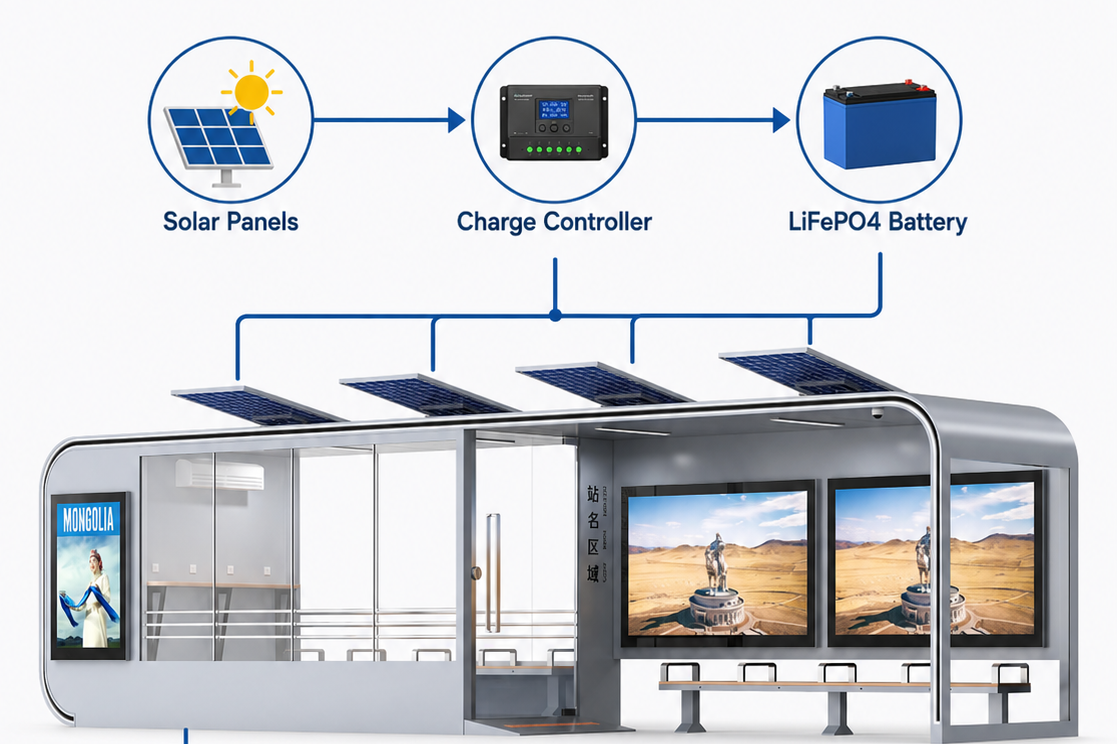
Solar panels generate direct-current electricity. Depending on the system architecture, that electricity passes through power electronics to supply the air conditioner, charge batteries, or support other shelter equipment.
A complete installation may include:
- Photovoltaic panels and mounting structures.
- An inverter and solar charge controller, or integrated hybrid equipment.
- Battery storage where required.
- An energy-efficient air conditioner.
- Lighting, passenger information displays, and communications equipment.
- Electrical protection, monitoring, and control systems.
In a grid-connected design, utility electricity can cover shortfalls. In an off-grid design, the solar array and batteries must support the specified service without that backup.
These are different engineering commitments. A shelter that uses solar electricity is not automatically capable of continuous, solar-only operation.
The answer depends on cooling demand, operating hours, and auxiliary equipment—not just shelter dimensions.
An air conditioner's cooling capacity describes how much heat it can remove. Its electrical input describes how much electricity it consumes.
For example, a unit delivering 3.5 kW of cooling at a coefficient of performance of 3.5 would require approximately 1.0 kW of electrical input at that operating condition:
Electrical input=Cooling output/Coefficient of performance
This is an illustrative relationship, not a product specification. Actual consumption changes with outdoor temperature, humidity, compressor speed, and installation conditions.
For procurement, request both cooling capacity and electrical input at the project's design temperature. A seasonal efficiency rating alone does not establish performance during extreme heat.
Air conditioning is only part of the energy budget. Advertising screens, lighting, ventilation, routers, and control equipment also require power.
Consider this hypothetical daily schedule:
| Equipment | Assumed average electrical load | Operating time | Daily energy |
|---|---|---|---|
| Air conditioner | 1.0 kW | 10 hours | 10.0 kWh |
| LED lighting | 0.06 kW | 12 hours | 0.72 kWh |
| Information display | 0.10 kW | 16 hours | 1.60 kWh |
| Controls and communications | 0.02 kW | 24 hours | 0.48 kWh |
| Total | — | — | 12.80 kWh |
These figures are design assumptions, not measured Ainl performance. The air-conditioning allowance represents average consumption during operation, not necessarily its nameplate input or maximum demand.
Large outdoor advertising displays can materially change the result. Ask for the proposed screen's average and maximum consumption at the intended brightness and content settings.
A preliminary estimate connects daily electricity demand with local solar availability:
PV capacity=Daily energy demand/(Peak sun hours×Net delivery factor)
Assume the example shelter needs 12.8 kWh daily, receives five equivalent peak sun hours, and uses an illustrative net delivery factor of 0.75.
The preliminary requirement is approximately 3.4 kWp. With hypothetical 450 W panels, eight modules would provide 3.6 kWp.
This calculation is useful for screening feasibility. It is not a construction-ready design.
A location may have long daylight hours but substantially fewer equivalent hours of full-strength sunlight.
Solar production also changes with:
- Seasonal weather.
- Panel orientation and tilt.
- Nearby buildings and trees.
- Dust and soiling.
- Module temperature.
- Electrical conversion losses.
Location-based modelling tools such as PVWatts can estimate monthly and hourly production. For a battery-backed shelter, those results must be combined with load and storage modelling; an annual generation total cannot demonstrate uninterrupted operation.
Panel quantity must translate into a buildable roof layout.
Suppose each selected module occupies approximately 2.1 square metres. Eight modules would occupy roughly 16.8 square metres before allowing for layout gaps, mounting details, drainage, equipment clearance, and maintenance access.
A compact shelter may not provide that space.
Possible responses include extending the canopy, adding an adjacent solar structure, reducing cooling demand, or choosing grid-assisted operation. Any extended canopy also requires structural and site approval.
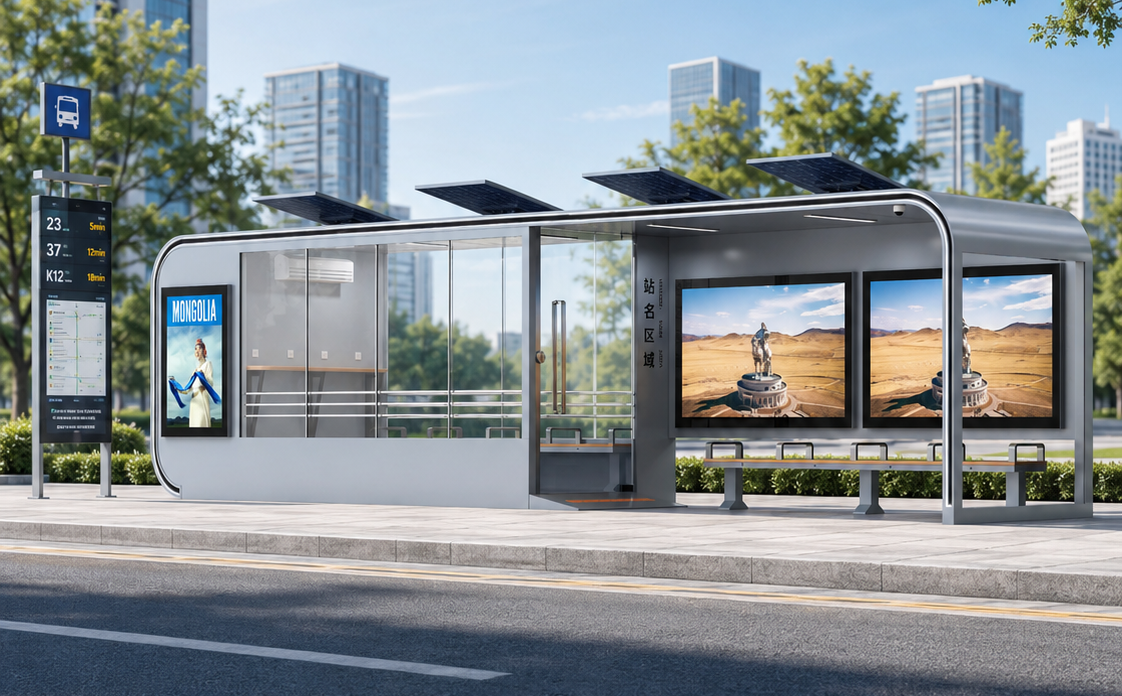
An open shelter and an enclosed waiting room need different cooling strategies.
A conventional air conditioner cannot efficiently maintain a stable indoor temperature when the "room" is continuously exposed to outdoor air. Hot air enters while conditioned air escapes.
Targeted cooling may improve comfort around particular seating positions, but it should not be marketed as equivalent to cooling an enclosed space.
For an enclosed air-conditioned bus shelter, useful measures include:
- External shading over exposed glazing.
- Solar-control glazing selected for the climate.
- Insulated roof and opaque wall sections.
- Well-detailed joints and door seals.
- Efficient lighting and display equipment.
- Door arrangements that limit unnecessary opening.
Glazing requires particular attention. A transparent shelter may look attractive while admitting substantial solar heat.
From a manufacturing standpoint, the enclosure, glazing, cooling system, and electrical package should be designed together—not purchased as unrelated components.
Reducing uncontrolled leakage does not mean eliminating fresh air.
An enclosed public shelter still needs a ventilation strategy suited to occupancy and local requirements. Outdoor air can add both sensible cooling load and moisture-removal demand.
Door-opening frequency also matters. A busy interchange may have a very different cooling profile from a lightly used suburban stop with the same floor area.
Battery sizing depends on the service promised after solar production falls.
A useful first question is: must the battery run the entire shelter, or only essential equipment?
For illustration, assume evening cooling and auxiliary loads average 1.2 kW for four hours. They require 4.8 kWh of delivered energy.
With an assumed 80% usable battery fraction and 90% discharge-path efficiency:
Nominal battery capacity=4.8/(0.80×0.90)≈6.7 kWh
That is a simplified starting point. A final design must address temperature effects, ageing, reserve capacity, permitted discharge limits, and the manufacturer's warranty conditions.
Battery energy capacity is also different from power capability. A battery may store sufficient energy but lack the discharge power needed by the selected equipment.
Storage does not create electricity. The solar array must still generate enough energy to serve daytime demand and recharge the battery.
The most suitable architecture depends on the site and the required level of service.
| Configuration | Useful application | Main limitation |
|---|---|---|
| Solar-only, without storage | Restricted daytime operation that can tolerate interruptions | Cooling follows available solar power |
| Off-grid solar with batteries | Sites without practical utility access | Requires careful autonomy and recovery sizing |
| Grid-connected solar | Sites where reducing purchased electricity is the priority | Standard grid-tied operation does not guarantee outage backup |
| Solar, battery, and grid hybrid | Projects needing solar contribution plus service continuity | More controls, protection, and commissioning requirements |
Where grid access is available and consistent cooling is important, hybrid operation deserves serious consideration.
For remote sites, compare the cost of utility extension against the full off-grid package. Include batteries, maintenance access, replacement planning, and the consequences of interrupted cooling.
A shelter can generate as much electricity annually as it consumes and still experience frequent shortfalls.
The relevant questions are hourly:
- Does production cover cooling during the afternoon peak?
- How much energy remains for evening passengers?
- What happens after consecutive cloudy days?
- Can the system recharge storage while serving normal loads?
Model the proposed operating schedule against local weather. For critical applications, assess difficult weather sequences rather than relying only on typical averages.
An intelligent shelter needs a clear operating hierarchy.
One possible sequence is to reduce advertising brightness, adjust cooling settings within agreed comfort limits, and preserve essential lighting and communications.
The precise priorities belong in the project specification. Accessibility, emergency functions, and passenger safety must guide the decisions.
A controlled reduction in nonessential consumption is preferable to an unexplained total shutdown.
Component certificates do not prove whole-shelter performance.
Acceptance testing should verify:
1. Indoor temperature and humidity under documented outdoor conditions.
2. Energy use with representative occupancy and door operation.
3. Solar production and battery charge behaviour.
4. Backup transfer and low-energy control sequences.
5. Condensate drainage, noise, and remote alarms.
Record test conditions carefully. Results from a mild, empty-shelter demonstration should not be presented as proof of hot-weather performance.
A solar bus shelter is public infrastructure. Its structure, serviceability, and electrical installation matter as much as its energy balance.
Ask suppliers to address:
- Wind loads, foundations, and panel uplift.
- Corrosion protection and coating specifications.
- Safe glazing and accessible passenger circulation.
- Battery location, thermal management, and applicable fire provisions.
- Electrical isolation, earthing, surge protection, and cable protection.
- Air-conditioner service access and condensate disposal.
- Cleaning access for panels, filters, and glazing.
Maintenance planning should be climate-specific. Dust, salt exposure, heat, and vandalism create different inspection requirements.
For cost comparisons, request a lifecycle breakdown rather than only a purchase price. Include installation, grid connection where relevant, electricity, cleaning, servicing, replacement components, and monitoring.
Without a defined location and specification, a universal price or payback promise would be misleading.
At Ainl, we bring 16 years of experience in developing, manufacturing, and supplying smart-city public facilities and outdoor advertising products.
Our manufacturing resources include approximately 150,000 square metres of factory space, provincial-level hardware and software research facilities, CNC sheet-metal processing, large-scale coating facilities, and electrical testing capabilities.
These resources support coordinated design across the shelter structure, finishes, equipment integration, and visual identity.
Our OEM/ODM scope includes dimensions, structural layouts, colours, screen configurations, lighting, solar power arrangements, and city-branding elements.
Company qualifications provide procurement context, but they do not replace project-specific calculations, local approvals, or acceptance testing. Cooling performance and solar autonomy should always be agreed against clearly stated conditions.
Send Ainl your project location, available footprint, operating hours, expected occupancy, target comfort conditions, display requirements, and grid availability.
Ask for a proposal that identifies the cooling-load basis, preliminary solar and battery sizing, energy-management strategy, maintenance access, and performance-verification plan.
That creates a stronger purchasing foundation than selecting a shelter by panel wattage alone.
Not directly. Night-time operation requires energy stored in batteries, electricity from the grid, or another supply. Battery sizing must cover the intended operating period and discharge losses.
Yes, when its solar array, storage, enclosure, and operating schedule are properly matched. Feasibility depends on local weather, available panel area, cooling demand, and the required autonomy.
There is no universal number. In the illustrative example above, eight 450 W panels provide a preliminary 3.6 kWp array. Another climate or operating schedule could require a substantially different design.
Not necessarily. Equipment must match the calculated load, airflow requirements, and humidity conditions. Oversizing can create unnecessary cost and operational problems rather than better comfort.
Yes, if both loads are included in the energy model. Screen size, brightness, operating schedule, and thermal output influence electrical demand and may also affect cooling requirements.
Start with the project location, shelter dimensions, service hours, occupancy, temperature target, display specifications, and grid availability. These inputs determine whether a proposed configuration is credible.
1. [U.S. Department of Energy — Consumer Guide to Home Heating and Cooling]. Supports the discussion of efficiency ratings, equipment sizing, and the limitations of oversized cooling systems. Residential guidance informs general principles, not public-shelter design requirements. [energy]
2. [U.S. Department of Energy — Solar Rooftop Potential]. Explains how roof area, orientation, shading, and geographical location affect solar potential. [energy]
3. [U.S. Department of Energy — PVWatts and System Advisor Model Webinar Guide]. Documents location-based solar estimation and access to monthly and hourly production results. [energy]
4. [National Renewable Energy Laboratory — A Homeowner's Guide to Window Air Conditioner Installation for Efficiency and Comfort]. Supports general principles concerning leakage, airflow recirculation, and maintenance; it does not establish shelter-specific savings. [docs.nrel]
5. [U.S. Department of Energy — When Saving Energy Helps Save Lives]. Describes integrated shelter-envelope modelling and solar–battery system analysis in military applications, rather than bus shelter performance. [energy]
6. [U.S. Department of Energy — Residential Central Air Conditioning and Heat Pump Installation Workshop]. Explains the relationship between enclosure characteristics, climate, and sensible and latent cooling loads. [energy]


